
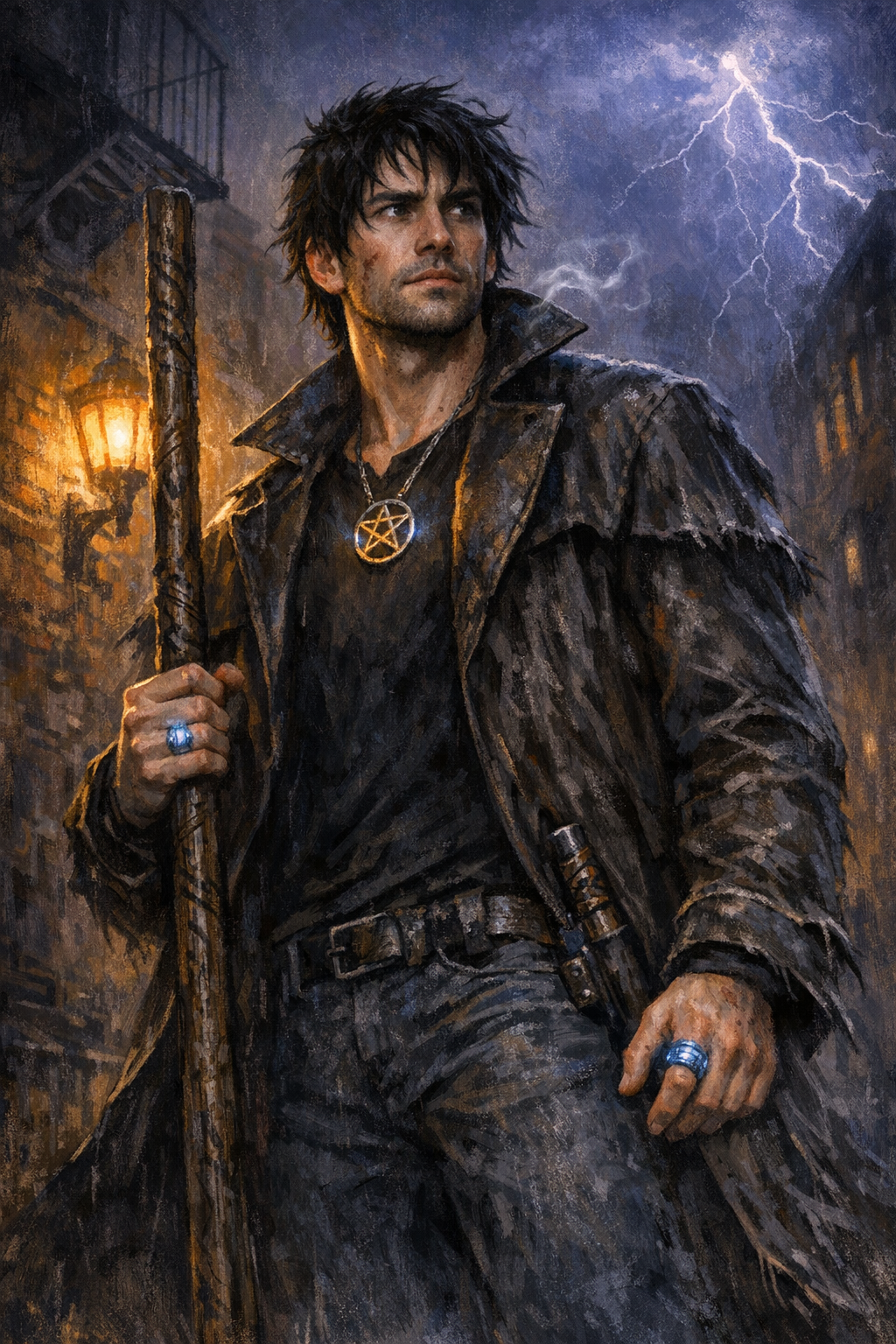
Harry Dresden
Harry Dresden
Spoiler-light through the inciting events of the first few chapters (the Madison Hotel murders, Monica's hiring, Morgan's first visit). The full-spoiler arc section at the bottom covers his choices through the climax — skip it if you haven't finished the novel.
In a sentence
Chicago's only openly practicing wizard — and the only one listed in the phone book under "Wizards" — who works as a private investigator and consultant for the Chicago PD's Special Investigations unit, and who is broke, tired, and about to take two cases on the same afternoon that will nearly get him killed.
Who he is in the story
Harry is the first-person narrator and the reason the series exists. He's six-foot-nine, lean, perpetually a paycheck behind, and almost always wearing a battered dark leather duster with a silver pentacle at his throat. His office is on the fifth floor of a downtown walk-up. His apartment is a converted basement two flights below street level, with a sub-basement under that where the real work happens — a chalk-floored lab with candles, a copper alembic, a workbench full of potion glass, and a rune-carved human skull named Bob.
The Chicago PD has a unit called Special Investigations — the squad that catches every case that doesn't fit the regular boxes. Special Investigations calls Harry when they can't explain something. The wider supernatural establishment — the White Council of wizards — keeps a Warden assigned to him, watching for any excuse to invoke a death sentence Harry has been living under since he was a teenager. Almost no one Harry meets is fully on his side, and almost everyone he meets is more dangerous than they look.
In Storm Front, Harry takes a missing-husband case from a frightened housewife and a consult call from CPD on the same afternoon. The two cases are connected, the connection is fatal, and Harry is the prime suspect on a murder he didn't commit before he's even worked out who did.
What he's like
Sardonic, stubborn, and disastrously chivalrous. He talks like the smart-ass narrator of a 1940s detective novel and acts like a 1940s detective hero — which is to say, he will take a beating to keep a stranger safe, refuse to back off a case after he's been told to back off, and apologize to women he's just rescued for not getting there sooner.
Under the wisecracks he is genuinely funny, genuinely kind, and quietly furious. He distrusts authority on principle, in roughly equal measure for the White Council, the police, the mob, and his own better judgment. He runs on bad coffee, worse sleep, and contrariness, and he is at his most dangerous when he is past the point where reasonable people would have called it a day.
He is also a wizard. Magic in this series is fueled by emotion and will, and Harry has more of both than is good for him. His combat magic is elemental and visceral — fire, wind, kinetic force discharged from a stored-energy ring — and his lab work is patient, chalk-and-candle thaumaturgy that involves a lot of pencils being chewed and a lot of arguments with Bob.
What he wants
To pay the rent. To keep Murphy from regretting that she works with him. To put away the warlock killing people. And underneath all of it, to be the kind of wizard his mother would have wanted him to be, in a profession that has spent his entire adult life telling him he's the kind of wizard who deserves to be killed.
What he fears / hides
Harry is on magical probation under what the White Council calls the Doom of Damocles. He killed his teacher, the man who raised him after his father died — a death the Council ruled self-defense by the thinnest possible margin. He is one bad working away from a Warden's sword. He spends Storm Front trying to solve a case where the police think he did it and the Council thinks he might have, and he cannot tell either side how much of his caution is rooted in that history. Murphy doesn't even know it exists.
Key relationships
- Karrin Murphy — the cop who hired him, trusts him about 70% of the time, and arrests him in chapter 16. The most important relationship in the book.
- Bob — the air-spirit-in-a-skull who is Harry's lab partner, walking grimoire, and source of unsolicited romantic advice. The friendship is sincere; the contract is older than Harry's grandfather.
- Susan Rodriguez — a reporter who's been chasing Harry for an interview and won't quit. By the third act she is something else, and Harry doesn't know what to do with that.
- Monica Sells — the client. Terrified and lying about why. Harry takes her case anyway.
- Warden Morgan — the wizard waiting for him to slip. They have a long and ugly history.
- Gentleman Johnny Marcone — the polite mob boss who would prefer not to have to kill him.
- Mister — the 30-pound housecat, threshold-keeper, and the only being in Harry's life who consistently knocks him onto his back when he comes home.
What he looks like
Tall enough that doorways are a problem — roughly six-foot-nine. Lean and rangy, broad-shouldered but not bulked-up. Shaggy dark-brown hair he keeps meaning to cut. Brown eyes, often shadowed from no sleep. Fair skin that bruises and burns easily and is almost always carrying one fresh injury he hasn't bothered to ice yet.
The look is consistent across the book and across the series: a battered dark-brown leather duster (his armor, his comfort, and his pocket organizer), a plain dark shirt under it, worn jeans, scuffed work boots, and the silver pentacle his mother left him resting in the hollow of his throat. He carries an oak staff carved with runic notches and a shorter blasting rod tucked through a belt loop. On his right hand, a force ring he's been building up with kinetic energy for over a year — it stores a charge that, when he triggers it, hits like a freight train.
For your book club
- Harry is openly a wizard in a world where most people don't believe in magic. Why does Butcher choose that setup, and what does the "wizard in the phone book" actually cost Harry across the book?
- His chivalry is mocked by Murphy on roughly chapter one and never stops being a problem. Is it a virtue, a coping mechanism, or both? When does it help him and when does it endanger people he's trying to protect?
- Harry lies to Murphy about pieces of the case in order to protect her. The book has very clear opinions about that choice. Do you?
- He spends almost the entire novel one Warden visit away from a death sentence. Does that pressure read as restraint, or paranoia? How would the book be different if Morgan didn't exist?
- By the climax, Harry has done magic he probably shouldn't have. Where, exactly? Is the Council right to worry about him?
Aliases
The following names and references in the book all point to this character. Use any of these as link anchors back to this page.
- Harry Dresden (canonical — the most common form)
- Harry Blackstone Copperfield Dresden
- Harry
- Dresden
- Mr. Dresden
Full-book spoilers
Stop here if you are still reading.
Harry's arc in Storm Front is the moment he discovers he can survive being the only wizard in the phone book — barely. The White Council, the CPD, the mob, the vampire courts, and a self-taught warlock all want him dead or off the case by chapter twenty. He chooses to stay on the case anyway. He scries the warlock's location through a working that strains his control to the edge of nosebleeds, drives to the lake-house ritual site in a storm with stolen hair and blood being used against him in absentia, and walks into a confrontation he should not be able to win.
He wins it by refusing the easy out. He could shoot Victor with the gun he brings — Bob explicitly tells him to "hit him first" — and instead he disrupts Victor's ritual circle and forces him to summon the toad-demon Kalshazzak inside a binding that Harry then breaks. The demon kills Victor. The house burns. Harry is trapped on a balcony in a building collapsing under him, and Morgan — Morgan, who has spent the book waiting for Harry to fail — appears on a neighboring balcony with his Warden's sword drawn, watches the entire fight, confirms with his own eyes that Harry has not broken the Laws of Magic, and saves his life by sword-cleaving a path back to ground.
The closing chapters are quiet on purpose. Harry wakes in the hospital bandaged and broke. Mister is in his lap. Bob is making jokes. Murphy comes by to apologize for the arrest and to ask, without quite asking, whether he is going to keep doing this work. He is. He always is. The next phone call rings on the last page in spirit — it just hasn't reached him yet.