
Morgan
Warden Morgan
Spoiler-light through his first arrival at Harry's office in chapter four. The full-spoiler section at the bottom covers the lake-house climax.
In a sentence
A senior Warden of the White Council — its execution arm — who has been assigned to watch Harry Dresden ever since the Council voted, by the thinnest margin in its history, not to kill him, and who arrives in chapter four convinced Harry has finally given them the excuse to finish the job.
Who he is in the story
The White Council is the world's governing body of wizards. It has Seven Laws of Magic. Breaking any one of them is a death sentence. Wardens are the people who carry the sentence out. Morgan is a senior one.
Harry was tried as a teenager for killing his teacher with magic. The Council voted to spare his life by a one-vote margin and placed him under the Doom of Damocles — magical probation, with a Warden assigned to watch him for the rest of his life. Morgan is that Warden. He has been waiting twelve years for Harry to give him a reason. In chapter four, two people have just been killed by a thaumaturgical working far above the skill of any plausible non-Council wizard. Morgan is at Harry's office before lunch.
For most of the book Morgan is a sword the reader keeps seeing the shadow of. He visits Harry in chapter four, accusatory and explicit; he resurfaces in chapter nineteen at the worst possible moment for Harry; and he arrives in person at the lake-house climax in chapter twenty-six. What he does there is the most important reversal in the book.
What he's like
Severe, literal, uncompromising — a soldier-priest of magical law who takes oaths seriously and consequences more seriously. His voice is flat and clipped; his preferred mode of conversation is silence. He does not insult Harry. He does not threaten Harry. He states the legal posture and waits for Harry to step over it.
He is, importantly, not a bad man. He is a true believer in the necessity of the Council's laws. The book lets you feel that, and lets you feel the resulting menace. Watching Morgan is like watching the trigger of a gun. He is not the danger; he is the mechanism that the danger uses.
What he wants
To do his job correctly. If Harry breaks a Law, Morgan wants to be the Warden who takes Harry's head. If Harry does not break a Law, Morgan wants to keep watching until Harry does. The framing is professional, not personal. The fact that Harry experiences it as personal is, in Morgan's view, Harry's problem.
What he fears / hides
That he might be wrong. The book never gives this to him directly, but the climax of chapter twenty-six does — Morgan stands on a balcony of the burning lake house with his sword drawn, watching Harry fight Victor in real time, and the look on his face when Victor goes down is not satisfaction. It is the recognition that he has spent twelve years aimed at the wrong target. He does not apologize. He does not need to. The fact that he sheaths the sword and saves Harry's life instead of finishing him is the apology.
Key relationships
- Harry Dresden — adversarial. Twelve years of watching, one near-execution at fourteen, and a chapter-four visit that more or less spells out the terms. The relationship will continue for many books and will not become a friendship until very late in the series.
- The White Council — his employer, his moral framework, his entire professional context. He is one of their most trusted senior Wardens.
- The Senior Council — somewhere off-page, his command structure. They sent him; they will hear whatever he reports.
What he looks like
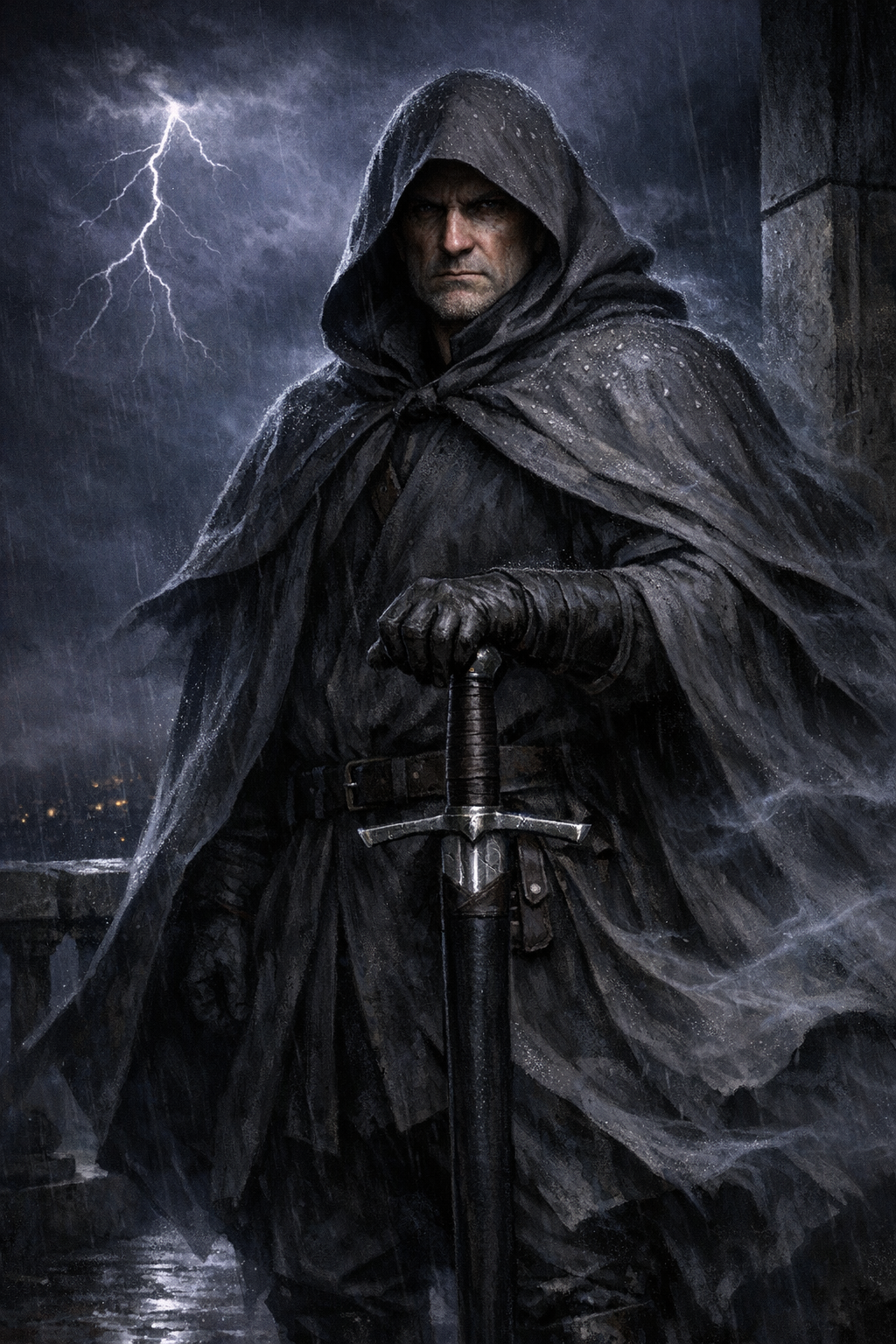
Late forties to early fifties, well over six feet, broad-shouldered, soldier's carriage, the square-on balance of a trained duelist. Iron-gray hair cut military-short. Hard-cut features that read weathered and battle-tested. Eyes that read cold even in shadow.
The Wardens dress alike, on purpose. A heavy slate-and-ash gray hooded cloak, rain-shedding, that moves wrong — the hem stirs as if in a wind that the rest of the scene cannot feel. Underneath: dark utilitarian layers, charcoal tunic or shirt, dark trousers, black or dark-brown military boots. A plain leather belt with a sword scabbard. The sword itself is unremarkable — a straight longsword, leather-wrapped grip, no ornament — and is the most dangerous object in any room he enters.
For your book club
- Morgan is the institutional pressure of the entire series in human form. Is he sympathetic to you? Should he be?
- The Council's posture toward Harry — guilty until proven not — is justified to them by the Laws. Is the book asking you to agree with the posture and disagree with the verdict, or to question the framework as well?
- Morgan saves Harry in chapter twenty-six. He does not apologize. Is that a complete arc, an incomplete one, or exactly the arc the character needs?
- Watch the way the book uses cloak motion as a tell. What does it mean that Morgan's cloak moves as if in a wind no one else can feel?
- If Harry had broken a Law during the climax — even narrowly, even justifiably — what does this book tell you Morgan would have done?
Aliases
The following names and references in the book all point to this character. Use any of these as link anchors back to this page.
- Warden Morgan (canonical — the most common form)
- Morgan
- the Warden