
Karrin Murphy
Karrin Murphy
Spoiler-light through her introduction in the first three chapters. The full-spoiler arc section at the bottom covers her break with Harry mid-book and the reconciliation in the closing chapter.
In a sentence
The Lieutenant commanding the Chicago PD's Special Investigations unit — five-foot-three of trained cop who calls Harry Dresden when a case doesn't fit on a normal evidence sheet and who will arrest him without hesitation when she thinks he's holding out on her.
Who she is in the story
Karrin Murphy runs the squad of detectives the CPD assigns to the cases nobody else wants — the weird ones, the unsolvable ones, the ones that come with paperwork no chief wants to sign. The job is a career graveyard inside the department, which means Murphy got it by being too good at her job not to promote and too uncompromising to politely retire. She works it like she's grateful for it, which is one of the reasons Harry likes her even when she's about to put him in cuffs.
She is Harry's primary client in Storm Front. She calls him to the Madison Hotel in chapter one, walks him past the tape in chapter two, and gets the first hard truth about the case from him by chapter three. She also, on the same day, learns that she has been working with a man whose entire skill set could plausibly have produced the murder she's investigating — and she doesn't pull him off the case, because she still needs him. She does, however, watch him.
What she's like
Brisk. Direct. Funnier than her face says. She speaks in clipped half-sentences when she's tense and in full ones when she's furious. She does not raise her voice — she lowers it. She handles her own gun, her own paperwork, and her own subordinates without theater, and she expects everyone around her to do the same.
Her relationship with the supernatural is professional skepticism with calluses on it. She has worked with Harry long enough to know that the wizard thing is real; she has not let that knowledge soften her standards. If anything, knowing magic is real makes her more exacting about what counts as evidence, because she is the one who has to make a case stick in a courtroom that does not believe in any of it.
What she wants
To protect her city. Specifically: the people on her watch, the cops on her squad, and the cases on her desk, in that order. She is willing to be unpopular, unpromoted, and personally bruised to do it.
What she fears / hides
That Special Investigations is one ugly headline from being shut down. That Harry — whom she likes, whom she relies on — is keeping something from her that will eventually get her killed or her people killed. That the brass upstairs would rather close cases than solve them and she will run out of political cover before she runs out of cases. She covers most of this by being the most competent person in any room she walks into.
Key relationships
- Harry Dresden — consultant, friend in some moods, suspect in others, and the working partnership that the rest of the series will spin around. Storm Front is the book that tests whether they can keep doing this.
- Detective Carmichael — her partner in Special Investigations, the openly skeptical cop who'd rather Harry not exist. She backs Carmichael's caution in the room and overrides him outside it.
- The CPD brass — bureaucratic gravity well; she manages them by giving them paperwork they can sign and outcomes they can announce.
- Chicago's underworld — Marcone's operation in particular. She works around them when she has to and against them when she can.
What she looks like
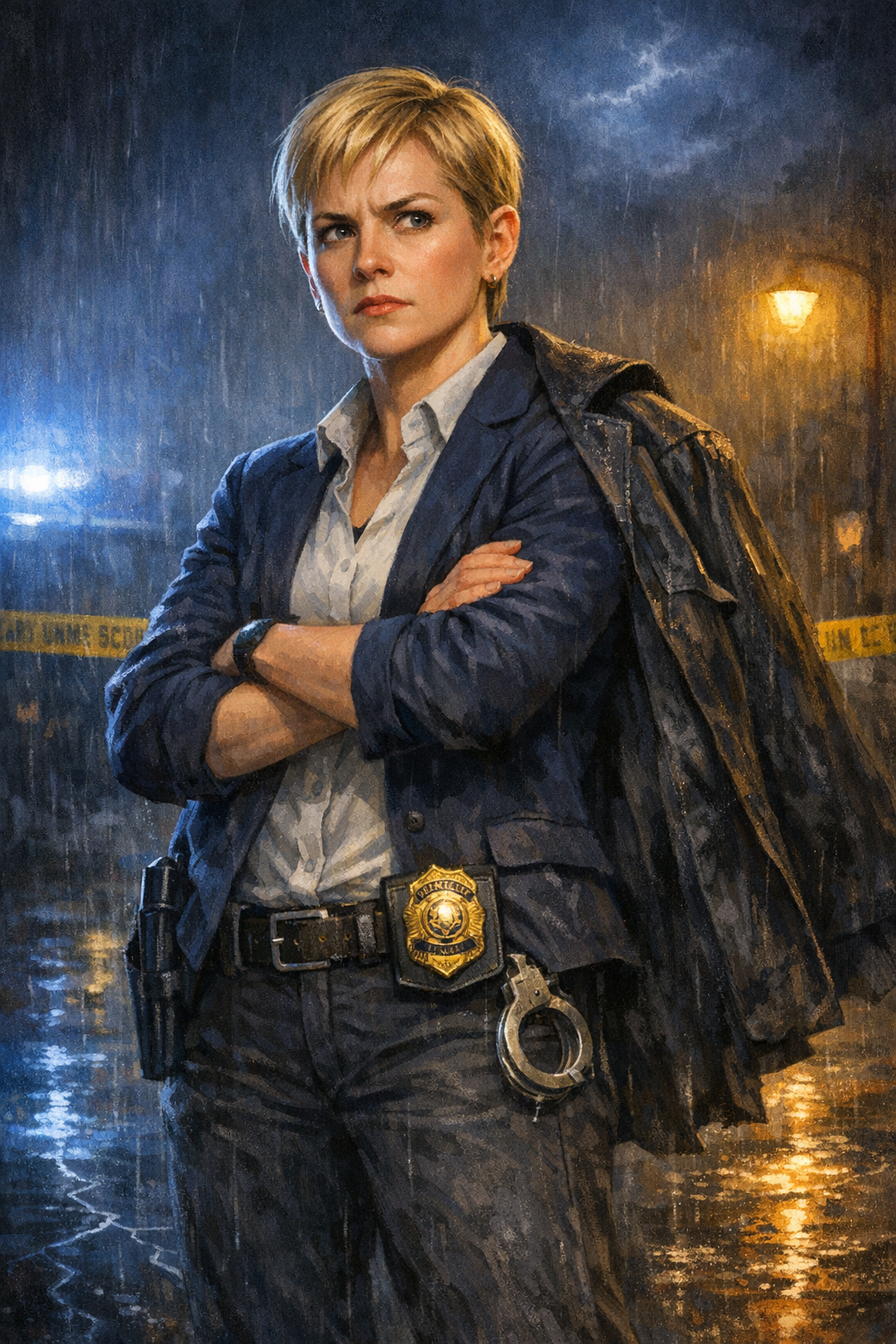
Short and compact — roughly five-foot-three — with the kind of athletic build that comes from years of judo and tactical training. Practical blonde hair cut short enough to stay out of her face in a fight. Square jaw, alert pale eyes, almost no makeup. Early thirties.
The working look is plainclothes detective: a fitted navy blazer or rain-darkened coat over a button-down, dark slacks, a CPD-issue Glock service pistol holstered at her hip, and her badge clipped at the belt on a leather flip wallet she snaps open with a practiced motion. In the field she adds a coat against Chicago weather and a no-nonsense expression that closes a hotel hallway faster than the police tape behind her.
For your book club
- Murphy hires Harry knowing she might have to arrest him. Is that a good practice, a necessary compromise, or both?
- She is repeatedly underestimated in the book — by Carmichael, by Marcone's people, by the brass, even by Harry. Track the moments where she uses that underestimation as a tool versus the moments where it costs her. Is she aware of doing it?
- The book uses her as Harry's audience for magical exposition. Does that work as a device, or does she end up smaller on the page than she should be? Where does the book get her right?
- She arrests Harry in chapter sixteen. From inside her POV (which we never see directly), is that the right call? What would have changed if she'd let him keep working?
- Her squad is a career graveyard for cops who can't be promoted upstairs. What does that say about the institution she's working inside?
Aliases
The following names and references in the book all point to this character. Use any of these as link anchors back to this page.
- Karrin Murphy (canonical — the most common form)
- Lieutenant Murphy
- Lt. Murphy
- Murphy
- Karrin