
Bianca
Bianca St. Claire
Spoiler-light through her single major scene in chapter nine. The full-spoiler section at the bottom covers the scene's consequences.
In a sentence
The vampire madam of the Velvet Room — Chicago's most discreet high-end escort service — who employed Jennifer Stanton and who receives Harry Dresden in her private suite to discuss her dead girl, with all the courtesy of a queen and all the underlying threat of a predator who has just lost something valuable.
Who she is in the story
Bianca runs the Velvet Room. The Velvet Room is the most expensive escort house in Chicago. The women who work for her are all human; the proprietor is not. Bianca is a Red Court vampire — the human-passing kind, in this book's terms, with a leathery batlike true form concealed under a perfect human "flesh-mask" — and she is one of the supernatural powers operating in Chicago at a level roughly equivalent to Marcone's, with which she keeps a careful peace.
Harry comes to see her in chapter nine because Jennifer Stanton was hers. He arrives hoping to get information about Jennifer's clientele, her habits, her week leading up to the Madison Hotel. He leaves with information, and with a "kiss" he didn't ask for. Bianca makes very clear by the time he leaves that she considers his investigation an inconvenience that she is choosing not to escalate — yet — and that her cooperation today is the most she is willing to extend.
What she's like
Polished, predatory, elegant. She wears civility like silk over steel. She moves with slow, controlled grace and speaks with measured courtesy that can tighten into threat without rising. She weaponizes proximity: scent, warmth, the slow invasion of personal space until the human across from her starts having trouble thinking.
The flesh-mask is impeccable. Most of her staff do not know what she is. Harry knows what she is because Harry knows what everyone in his version of Chicago is. The book treats the kiss as a deliberate assertion of power, not a romantic gesture, and the language around it makes that distinction precise.
What she wants
Order in her house. Her girls safe — not for sentimental reasons, though she may also have those, but because attrition is bad for the business. The investigation of Jennifer Stanton's death closed, ideally by someone other than herself. The supernatural community in Chicago kept invisible to the human authorities. Marcone kept on his side of the line.
What she fears / hides
That she is not, in fact, untouchable. The Red Court has internal politics. She is in Chicago in this book because Chicago is where her court has positioned her, and that positioning depends on her keeping the Velvet Room quiet and the local supernaturals on a working peace. Losing Jennifer is a problem. Losing more would be a much larger one. She projects total composure because total composure is the most expensive thing she has to project, and she is good at it.
Key relationships
- Jennifer Stanton — one of her girls. Bianca's affection for Jennifer is real and the book lets you feel that without sentimentalizing it.
- Harry Dresden — adversarial détente. He is the wizard in her parlor. She would prefer not to escalate; she demonstrates exactly how far she is willing to go if she has to.
- Marcone — peer power, careful neighbor.
- The Red Court — her larger context, off-page in this book but felt.
What she looks like
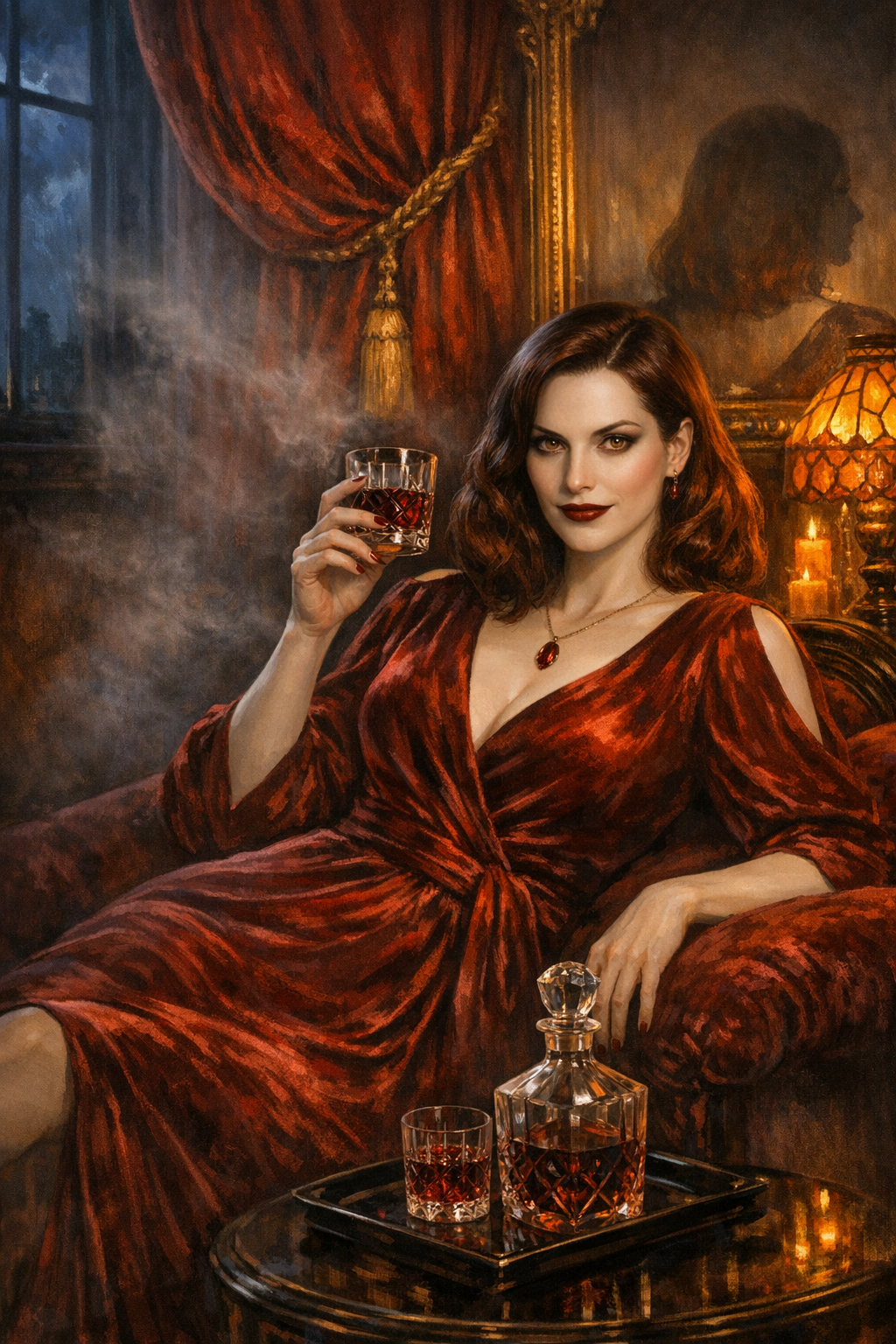
In her human flesh-mask, late twenties to early thirties, statuesque and poised. Sleek dark auburn hair styled in soft waves to the shoulders. Pale, flawless porcelain complexion. Large, slightly-too-still hazel-amber eyes that lock on a target and rarely blink. A small predatory half-smile. Lips painted oxblood.
The scene is set in her private suite. The wardrobe matches the room: a floor-length deep-crimson silk-velvet evening gown with a low neckline and long slit sleeves, gathered at the waist with a silk sash; a single garnet pendant at the throat. The Velvet Room is exactly what its name promises — red velvet drapery, black-lacquer trim, gilded antique mirrors, amber Tiffany-style lamps, a crystal decanter of dark red liquid on a black-lacquer tray. Bianca's true form — the leathery batlike Red Court visage under the mask — does not appear on the page in this book.
For your book club
- Bianca's kiss reads, in narrative effect, as an assault — and the book never uses the word. How does Butcher use vampire conventions to talk about coercion and consent without saying those words directly? Is the indirection effective or evasive?
- The Velvet Room is staffed by human women who work for a vampire and mostly do not know it. What does the book think about consent inside that arrangement? What do you think about it?
- Bianca and Marcone are peer powers in this novel and act like it. Track the moments the book treats civilized power as a kind of camouflage. Where is it sympathetic and where is it the trap?
- Storm Front gives Bianca exactly one chapter. Is that the right amount of her, or does the book leave her unexamined in a way that flattens her into "the vampire scene"?
Aliases
The following names and references in the book all point to this character. Use any of these as link anchors back to this page.
- Bianca St. Claire (canonical — the most common form)
- Bianca
Full-book spoilers
Stop here if you are still reading.
Bianca's chapter is structurally important even though it is short. She gives Harry the name Linda Randall, which is the lead that pulls him into the Sells family's actual situation; her "kiss" is also what makes Harry vulnerable enough — physically and emotionally — to be off-balance for the next several chapters, including the date with Susan and the demon attack. The series will reuse Bianca, and her arc with Harry will become deeply ugly across the next two novels. Storm Front is restrained on purpose here; it lets you sense the courtly menace without giving you the full Red Court politics yet.