
Chapter 9
The chapter in one sentence
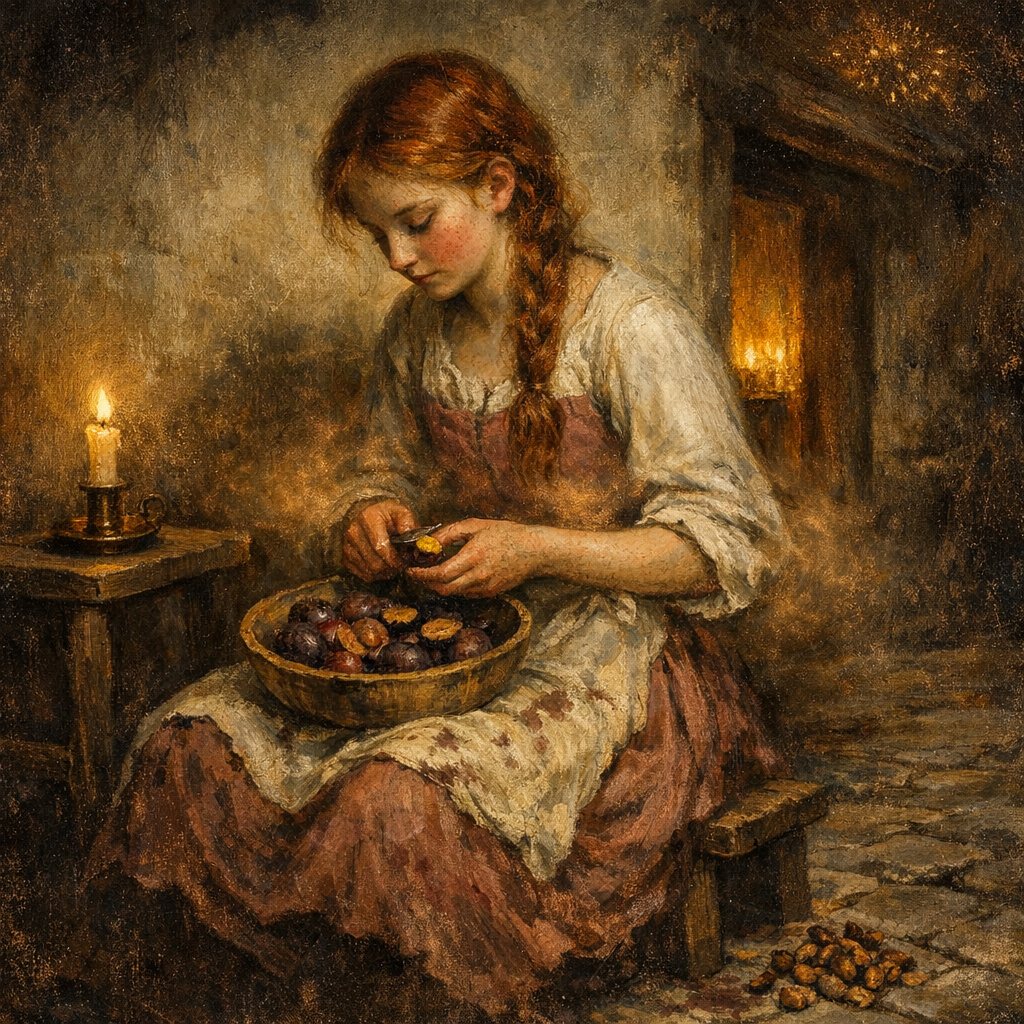
TL;DR: In the dim back courtyard off rue de Marais, with the red-haired girl dead at his feet and her scent already fading from her cooling skin, Grenouille has the one true revelation of his life — that perfume is something that must be taken, and fixed, and that this is now his work.
Spoilers through Chapter 9.
Süskind closes the murder scene with the protagonist's vocational manifesto, delivered without dialogue, in absolute silence, by a small dark figure standing over a body.
What happens
The chapter is the murder's afterword. Grenouille remains in the courtyard for a few minutes more, inhaling the slow loss of the scent he has just ended. The fragrance, even with its source still in front of him, is evaporating. He registers, with the cold precision of a chemist watching a reagent, that he has captured nothing — that the most beautiful thing he has ever smelled is, at this moment, irretrievably leaving the world.
The understanding crystallizes. He must learn how to hold a scent. To extract it, to fix it, to bottle it, to make it durable. The girl is gone; the scent is going; the vocation is born. By the time he slips out of the courtyard, the corpse is already secondary. What he is leaving with is a problem to solve.
Key moments
- The fading scent. The chapter's defining image: a man standing over a body, in love with a smell that is leaving.
- The vocation. Grenouille's first conscious plan. He will become a perfumer. Not for art, not for craft, but for storage.
- The exit. No remorse. No fear of capture. The girl is forgotten before he has finished walking out of the courtyard.
Character shifts
Grenouille has now committed his first murder and understood his life's work. The two facts are inseparable from this point forward. The man who walks out of the courtyard is in some sense the man who walks toward the scaffold in chapter 51 — the trajectory is set.
Why it matters
The book's central horror — and its central artistic argument — is established here. Grenouille's project is not malice. It is technical. He has discovered the limit of his medium and is now committed to surpassing it, and the medium happens to require human bodies. Süskind's prose lets the realization happen without any of the moral language a less rigorous writer would have inserted. Grenouille feels no guilt because the chapter is not asking him to. The reader, however, is.
Themes to notice
- The artist as monster, the monster as artist — given its purest formulation. Grenouille's craft and Grenouille's killing are the same gesture.
- Identity as something you have to make for yourself — the vocation is, retroactively, the self he has been missing.
- Smell as the sense reason can't argue with — including the reason that should be arguing him out of the courtyard.
Book club questions
- Süskind grants Grenouille a vocational epiphany in the same breath as a murder. The book asks you to take both seriously. Are you able to?
- The girl has been a body for several pages and Grenouille's attention has been entirely on the scent leaving her. What is Süskind doing with that displacement?
- If Grenouille had figured out enfleurage in chapter 9 — if the technique had been available to him in Paris — would the book be better, or worse, or simply different?
Visual memory hook
A small dark figure standing motionless over a fully-clothed teenage body in a candlelit courtyard, head tilted slightly back, breathing in the last molecules of a scent that is leaving the world.
What's next
Chapter 10 picks Grenouille up the next day, follows him by nose through Paris until he locates the one shop in the city where someone might be paid to teach him how to fix a scent, and stops him on the threshold of Baldini's perfumery on the Pont au Change.