
Chapter 10
The chapter in one sentence
TL;DR: Drawn through the human reek of Paris by the scent of distilled flowers and balms, Grenouille locates the dim, river-lapped, fading shop of the perfumer Baldini on the Pont au Change — the one address in the city where a man might be taught how to capture a scent and not let it go.
Spoilers through Chapter 10.
The chapter is a transition, but it is one of the book's most beautifully observed: the protagonist's nose finds his teacher's shop without anyone having told him where to look.
What happens
The morning after the murder, Grenouille is in the streets again, walking the thread of an entirely different problem from the one that drove him to the plum girl. He needs to find the place in Paris where the making of scent happens. He has no map, no directory, no introduction. What he has is a nose.
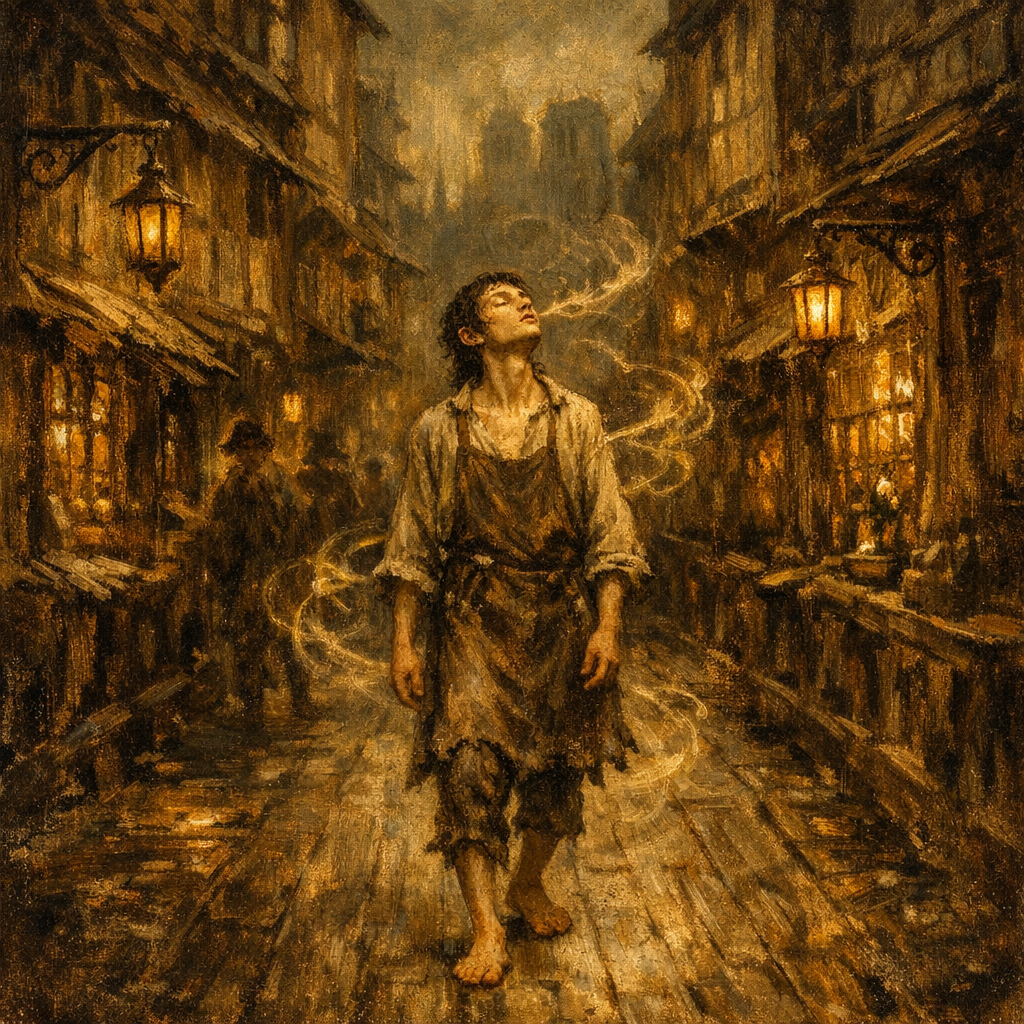
He tracks perfume the way he tracked the plum girl — by following its trace through the river-and-tannery reek of the city — until the trail leads him onto the Pont au Change, the bridge canyon of crooked timber-framed shop-houses jettied out over the Seine. At one of those shop windows the air is denser with rose, jasmine, neroli, civet, ambergris than anywhere else in Paris. Inside, in the dim afternoon light, an aging Italian-trained perfumer is brooding over the eclipse of his trade.
Grenouille does not yet enter the shop. He registers the address. The chapter ends with him standing in the bridge canyon outside, having located, by smell alone, the only door in Paris he wants to walk through.
Key moments
- The nose-tracking through the city. A second sustained set-piece (after the chapter-6 atlas) of Grenouille reading Paris like a map.
- The bridge canyon. Süskind's most cinematic location — narrow, leaning, lantern-lit, glass-twinkling, river-rotted.
- The window. A small dark figure on the bridge, motionless, head tilted up at a perfumer's bay window. He has found his teacher.
Character shifts
Grenouille shifts from murderer to applicant. He has a problem and is on his way to find a man who solves it for a living.
Why it matters
The chapter is the bridge between the plum girl's courtyard and the next ten chapters of formal apprenticeship. It also gives the book its first long look at the Pont au Change, which will be both Baldini's domain and, by chapter 22, his grave.
Themes to notice
- Identity as something you have to make for yourself — Grenouille is now organizing his life around the vocational discovery of chapter 9.
- Smell as the sense reason can't argue with — including as a wayfinding instrument that requires no city map.
- Pre-Revolutionary France as a body that knows it's rotting — the bridge over the rotting river is a beautifully literal image of a society overbuilt on a base that's failing.
Book club questions
- Grenouille can't read. He can't ask directions. He has never been told that perfumers exist as a trade. He nevertheless locates Baldini's shop by smell alone. Is the book asking us to admire this, or to be afraid of it?
- The chapter delays the introduction of Baldini by half a chapter. What does the postponement of the meeting do to your sense of the protagonist?
Visual memory hook
The receding canyon of the Pont au Change at late afternoon, leaning timber shop-houses on either side, lanterns swinging, glass twinkling in narrow windows — and a small thin figure walking slowly down the center of the bridge with his head tilted slightly back.
What's next
Chapter 11 enters Baldini's shop without Grenouille and gives the reader a sustained portrait of the master perfumer Grenouille has just located — a man already, before he knows it, in financial decline and on the lookout for a miracle.