
Chapter 8
The chapter in one sentence
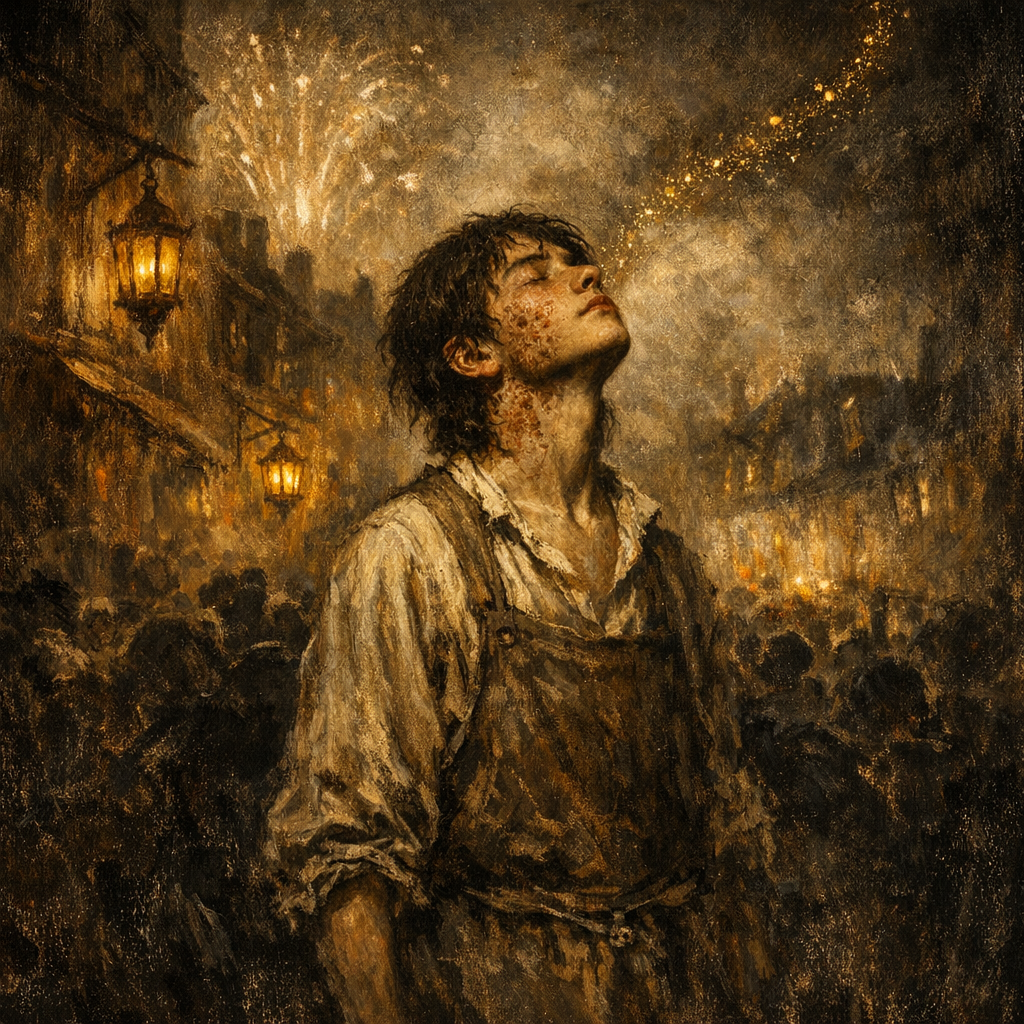
TL;DR: Amid coronation-anniversary fireworks, Grenouille isolates from the festival reek of Paris a single thread of scent more sublime than anything he has ever known, follows it through the Marais to a courtyard off rue de Marais, and finds a teenage girl pitting plums whom he silently strangles and inhales — the first murder in the book and the discovery that scent is something one can take.
Spoilers through Chapter 8. The book's first murder.
The structural turning point of Part 1: Grenouille's nose stops being an instrument of cataloguing and becomes an instrument of acquisition.
What happens
It is a fireworks night in the early 1750s. The city is in the streets. The air over Paris is thick with sulfur smoke from the rockets, tallow smoke from the festival lanterns, river rot from the Seine, sweat from the pressed crowd. Grenouille is in it, doing what he always does — and stops mid-step, head tilted back. Above the reek he has caught a fragrance no human he has ever passed has produced.
He follows it. Through alleys, past shuttered shops, into the Marais, threading the crowd by nose alone. The trail leads him to a small enclosed back courtyard off rue de Marais. There, lit by a soft rectangle of candle-gold from a low doorway, a teenage girl sits on a stool pitting plums with a small steel paring knife, absorbed, humming. Her scent — half-veiled by the sugary tang of the fruit — is the most beautiful thing Grenouille has ever smelled.
He slips up behind her. He covers her mouth and nose. He strangles her without struggle. He lays her on the cobbles and inhales her, methodically, every part of her cooling skin — without any sexual touch. Süskind is precise: this is not a sexual murder. It is a scent harvest. Grenouille leaves the courtyard understanding, for the first time, what scent could be made to do and what he will spend the rest of his life doing about it.
Key moments
- The thread above the reek. Grenouille's pause on the quai — the chapter's pivot. The hunting begins.
- The track through the Marais. The reader follows Grenouille follow the scent. The prose becomes the nose.
- The courtyard. Süskind's signature image: a girl alive in candlelight, absorbed in plums.
- The kill. Quiet. No struggle. No commentary. The narrator's restraint is the chapter's most disturbing choice.
- The inhalation. The most haunting paragraph in Part 1: Grenouille methodically nosing along hairline, nape, breastbone, belly, drinking the scent, registering the imminent loss as it begins to evaporate.
- The vocation. The chapter ends with Grenouille's understanding crystallized: he must one day capture and fix such a scent.
Character shifts
Grenouille acquires a vocation. The plum girl acquires the most haunting role in the book: the first body, the keystone memory, the missing top note Grenouille will spend forty more chapters trying to recreate.
Why it matters
This is the chapter where Perfume becomes the book it has been promising to be. The first half — birth, fish market, orphanage, tannery, scent atlas of Paris — was the long approach. This is the moment the protagonist's gift collides with another person and the consequence is murder. From here forward every page is downstream of this courtyard.
Themes to notice
- The artist as monster, the monster as artist — established here, in two paragraphs, with no possibility of rescue. Grenouille's vocation is born and his crime is born in the same gesture.
- Smell as the sense reason can't argue with — and as the engine of irreversible action.
- Worship as the most dangerous reflex — its inverse: predation, also automatic, also undefended.
Book club questions
- Süskind explicitly notes that Grenouille does not touch the girl sexually. Why does it matter that the murder is not erotic — and is the book trying to disqualify the obvious reading or do something stranger?
- The plum girl is unnamed throughout the book, while the twenty-fifth victim, Laure Richis, has a name and a family and a long lead-up. What's Süskind doing with the difference?
- The chapter is, technically, a courtyard scene. Why is the city — the festival outside, the fireworks, the sulfur smoke — so important to the staging?
Visual memory hook
A girl on a low stool in a candlelit courtyard, bowl of plums in her lap, paring knife in hand, humming — and a small dark figure entering the frame from the upper-left edge.
What's next
Chapter 9 stays in the courtyard a little longer, catches Grenouille's epiphany as the girl's scent fades, and lets the reader watch him understand exactly what kind of man he is going to spend the rest of his life becoming.