
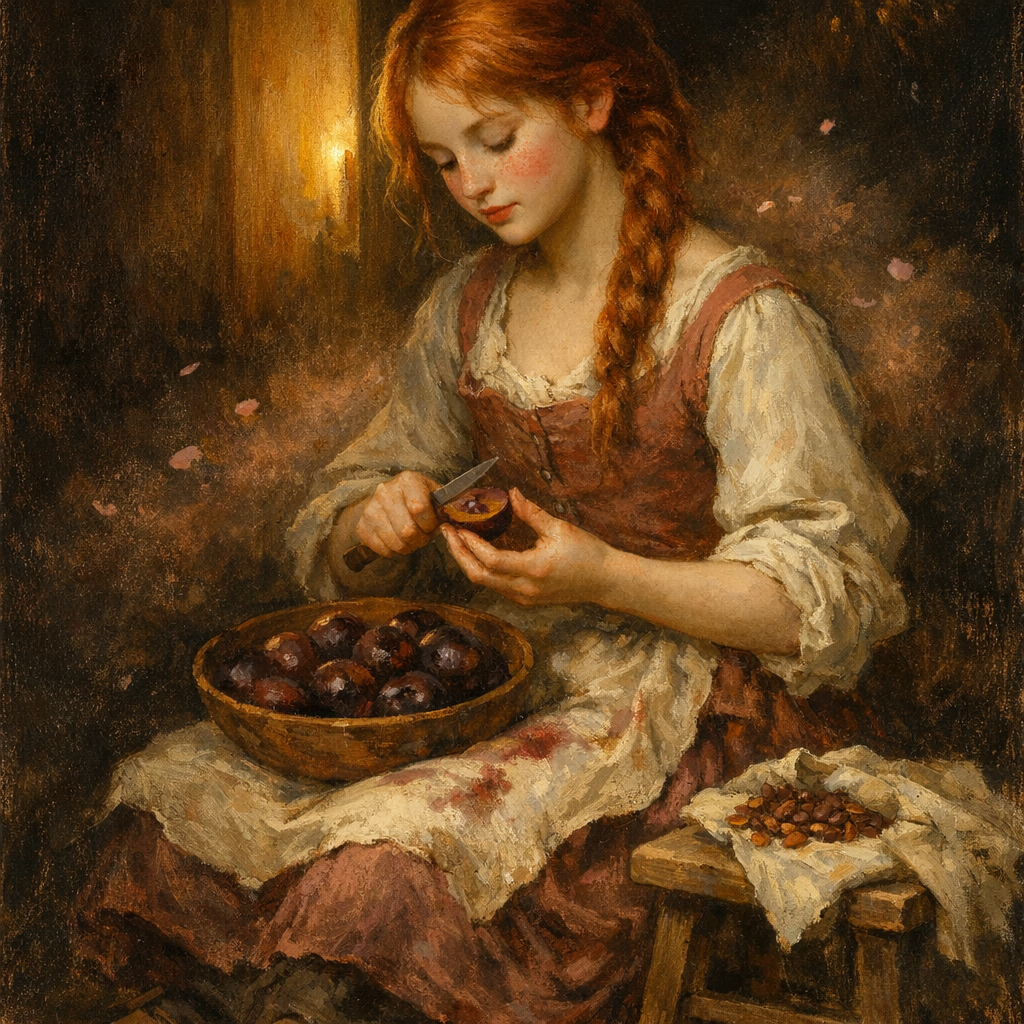
The Plum Girl
The Plum Girl
TL;DR: The unnamed Paris teenager Grenouille tracks across half the city by scent on a fireworks night and strangles in a quiet courtyard off rue de Marais — the first murder in the book, the discovery that scent is something one takes, and the keystone memory Grenouille spends the rest of his life trying to recreate.
Spoilers through Chapter 9. Includes Grenouille's first murder.
Snapshot
A red-haired Parisian girl of fourteen or fifteen, plain and luminous, sitting alone in a back courtyard pitting plums on the night of a coronation-anniversary fireworks display. She is alive in the frame for less than a chapter. The book is haunted by her for the rest of its length.
Role in the story
She is the moment Perfume turns. Grenouille has been mapping the smells of Paris like a private cartographer for years; on a fireworks evening in the early 1750s he isolates, above the festival crush of sulfur and tallow and crowd-sweat, a single thread of scent he has never registered before. He follows it through the Marais to a courtyard off rue de Marais and finds her — pitting plums, absorbed in her work, glowing with a fragrance no flower or fruit has ever produced.
He strangles her, methodically. He inhales her body, methodically. He understands, in that moment, what perfume can be. He leaves before her scent has finished evaporating, with a vocation that will produce twenty-four more bodies before it's finished.
The plum girl is never named. The book does not give her dialogue, family, history, or future. Süskind's refusal of those things is a moral choice — she is the origin Grenouille spends the rest of the novel trying to capture, and the book is determined not to let Grenouille's hunt overwrite her.
Personality in plain English
We see her from the outside. She is engrossed in her plums. She is humming. She is fully present in her body and her work. The horror of the chapter is precisely how alive she is in the moment before he reaches her.
What she wants
To finish pitting the plums. The novel grants her this, and only this.
What she fears (or hides)
She is not given the time to fear anything. The book lets her be unguarded — a girl in a courtyard on a festival night — and then closes the chapter.
Key relationships
- Grenouille — predator, then for the rest of the book, ghost-keystone. He never stops trying to recreate her scent.
Visual identity
Mid-teens, fourteen to sixteen. Long copper-red hair, lightly braided over one shoulder. Pale freckled skin, fresh colour. Slim, on the cusp of adulthood. Working-class hands. Plain linen chemise with the sleeves pushed to the elbow, a wool kirtle in dusty rose over a darker petticoat, a linen apron juice-stained from her work. No cap; her hair is uncovered for the indoor task. Wooden clogs on the cobbles. A wooden bowl of halved plums in her lap, a heap of plum stones beside her, a small steel paring knife in her hand. Behind her, a soft rectangle of candle-gold from a low doorway.
Aliases
The following names and references in the book all point to this character. Use any of these as link anchors back to this page.
- The plum girl (canonical — the most common form)
- The red-haired plum girl
- The girl in rue de Marais
- The first murder