
Chapter 22
The chapter in one sentence
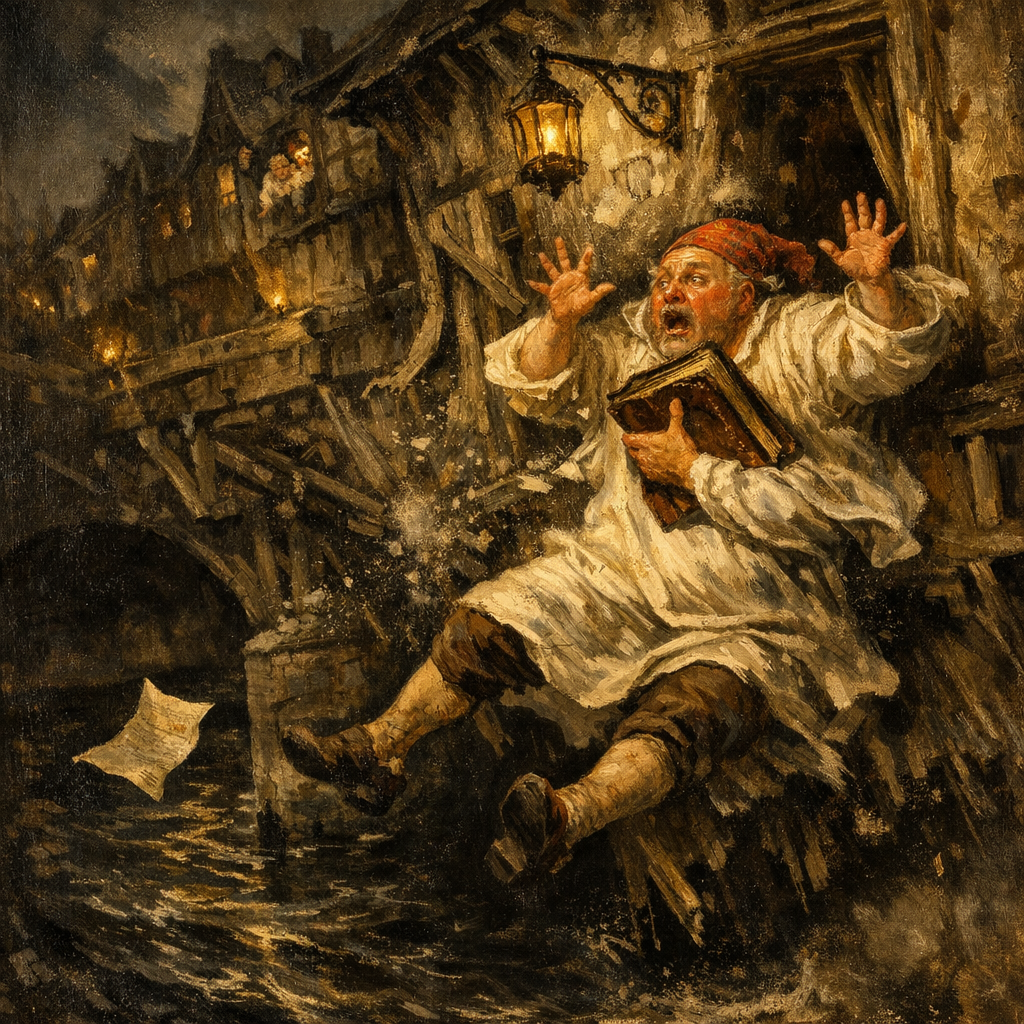
TL;DR: In the damp Paris night the same evening Grenouille leaves the city, the overcrowded Pont au Change finally gives way — pilings cracking, shop-houses tilting, the Seine swallowing the bridge — and Giuseppe Baldini, with his perfumery and the leather formulary of every recipe Grenouille ever wrote down, drops into the river.
Spoilers through Chapter 22.
The closing chapter of Part 1 collects on the book's structural promise: men who use Grenouille do not survive him.
What happens
The Pont au Change, an overcrowded medieval bridge of leaning timber-framed shop-houses, has been failing for years. On the night Grenouille walks out of Paris, it finally goes. Pilings crack; mortar dust rains down; one shop-house tilts outward over the river; lanterns swing wildly on their hooks. Baldini — surprised in a white nightshirt and red brocade nightcap, the leather-bound formulary clutched to his chest — falls into the Seine. A single torn page flutters away on the wind.
The book treats this as elegant book-keeping. Baldini did not deserve to die, the prose suggests, more than anyone else who has used Grenouille; the universe of Perfume simply does not let people use him and then keep their lives. The bridge that built him is the bridge that ends him.
Key moments
- The collapse. Süskind grants the bridge a paragraph of catastrophe — pilings, mortar, lanterns, the river.
- The fall. A heavy man in a nightshirt with a ledger, suspended for one suspended candlelit instant in disbelief.
- The torn page. A single recipe page fluttering away on the night wind. The book's elegy for the work.
Character shifts
Baldini completes his arc — from theatrical decline to flush success to drowning, all within a year. Grenouille, already on the road south, never knows.
Why it matters
The chapter closes Part 1 with the book's most explicit demonstration that being used by Grenouille is a fatal condition. The reader watches the pattern install itself: it will recur with the Marquis, with Druot, and — as a partial inversion — with Antoine Richis. Süskind also uses the chapter to rid the book of the Paris setting in a single image; from chapter 23 forward the novel will be a road book, then a cave book, then a Provence book.
Themes to notice
- The artist as monster, the monster as artist — and the consequences the artist's medium produces, even at distance, even without intention.
- Pre-Revolutionary France as a body that knows it's rotting — the literal collapse of the bridge is the book's coldest joke about a society overbuilt on a base that's failing.
Book club questions
- Süskind kills Baldini offstage from Grenouille — the protagonist never learns about it. What does the structural choice do to your sense of the book's universe?
- Is the bridge collapse fate, irony, or simple mechanics? Does the book want you to be able to tell?
Visual memory hook
A heavy man in a white nightshirt and red brocade nightcap suspended, mid-fall, against the cold-black Seine, a leather-bound formulary clutched to his chest, a single torn page fluttering away on the wind.
What's next
Chapter 23 is on the road south with a small thin figure walking in the ditch beside the high road, glad to be alone.