
Druot
Druot
TL;DR: Madame Arnulfi's burly journeyman perfumer and live-in lover — the man who teaches Grenouille the cold-fat enfleurage technique that becomes his murder method, and the man who, in the book's most concentrated injustice, is hanged in Grenouille's place at the end.
Spoilers through Chapter 51.
Snapshot
A sun-browned, broad-shouldered Provençal artisan in his late thirties, comfortable in his arrangement with Madame Arnulfi, slightly proprietary of the workshop — the most ordinary good man in the book, doomed.
Role in the story
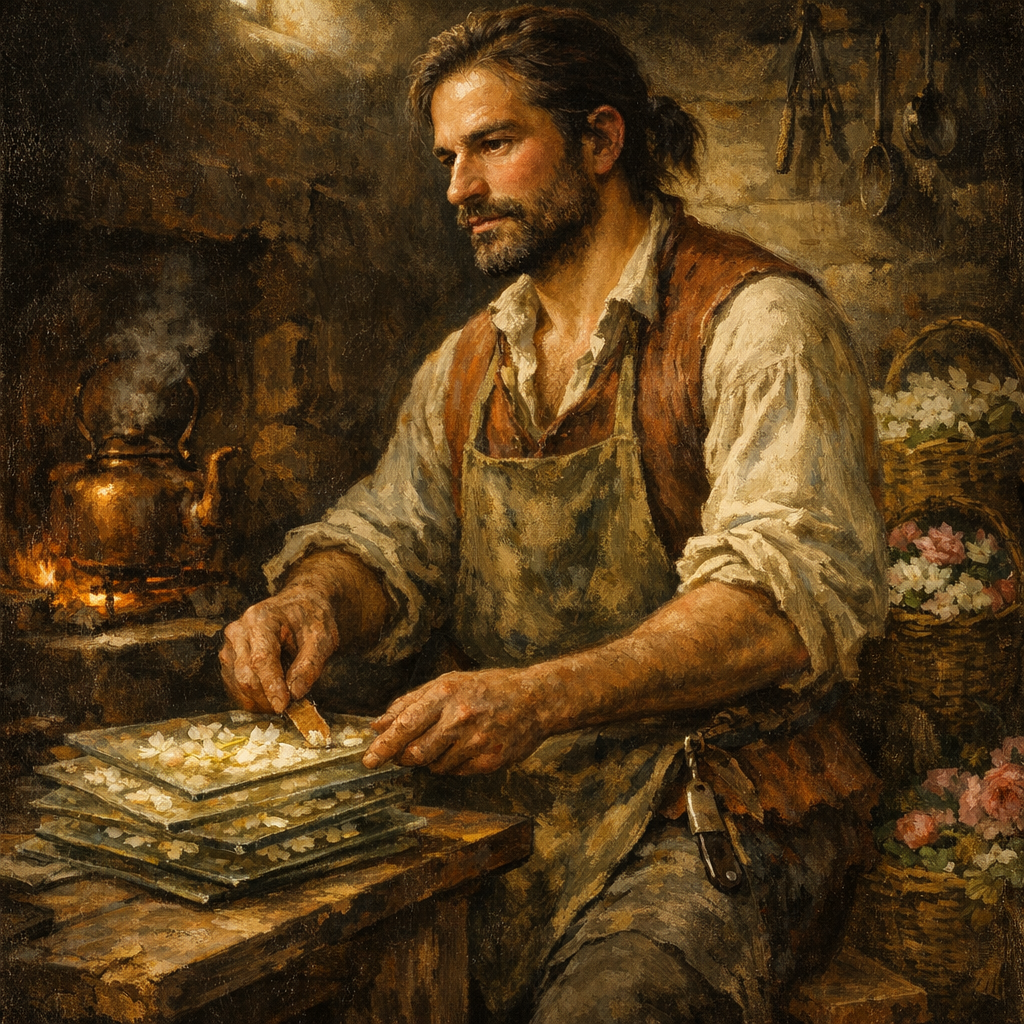
Druot teaches Grenouille his trade. The cold-fat enfleurage technique — laying glass plates of fresh fragrant petals over animal fat to draw the scent into the medium — is the procedural keystone of the whole back half of the book. Druot teaches it to Grenouille blamelessly, in the normal course of a journeyman's instruction, and Grenouille spends the spring of the murder campaign applying it to the bodies of twenty-five young women.
Druot himself does nothing wrong. He is mostly off-page during the killings — in the workshop, in Madame Arnulfi's bed, on the mountain harvesting jasmine. After Grenouille is unmasked at the execution by the perfume itself, the Grasse magistrates — refusing to admit that they have just publicly pardoned the actual murderer — pin the crimes on the journeyman whose hands had touched the most glass plates and whose alibi was a relationship with the workshop's owner. He is hanged.
He is the book's purest victim of injustice. The savagery of his ending is not an accident; it is one of Perfume's structural arguments about what towns will do, on perfume's behalf, to men who do not happen to smell magical at the right moment.
Personality in plain English
Sturdy, decent, physical, not bookish. Comfortable in his arrangement with Madame Arnulfi. A working-class artisan, not unkind, occasionally proprietary. Slightly irritated by Grenouille's better nose but not threatened by him — Druot is competent, knows it, and has no need to compete with the strange new hand who's clearly his social inferior.
What he wants
To run Madame Arnulfi's workshop competently, eventually marry her, and keep doing the trade he is good at. The book does not let him have any of these.
What he fears (or hides)
Almost nothing. He is the kind of man whose interior is organized like his apron — folded, used, set aside, put back where it belongs.
Key relationships
- Madame Arnulfi — his employer, lover, partner. The book treats their arrangement with quiet respect.
- Grenouille — his apprentice in cold-fat enfleurage. He teaches the technique willingly. He is hanged for what Grenouille does with it.
Visual identity
Tall, broad-shouldered, strong-armed — the body of a man who has spent years stirring kettles and lifting heavy glass enfleurage frames. Sun-browned skin from outdoor work in the lavender fields and walled courtyards of Grasse. Mid-brown hair pulled back into a short loose queue. Trimmed dark beard or three days of stubble. Capable work-stained hands. Coarse linen shirt with sleeves rolled to the elbow, russet wool waistcoat, heavy linen apron stained green with plant matter and brownish with pomade fat. Dark wool knee breeches, thick wool stockings, sturdy leather work shoes. A small folding knife on a string at his belt. The defining image is Druot at a stone bench, scraping fragrant fat from a glass enfleurage plate with a small wooden palette knife — the same gesture that, applied to a different surface in chapter 37, becomes a murder.
Aliases
The following names and references in the book all point to this character. Use any of these as link anchors back to this page.
- Druot (canonical — the most common form)
- The journeyman