
Antoine Richis
Antoine Richis
TL;DR: The wealthiest man in Grasse, second consul of the city, widower, devoted father — and the only character in Perfume to deduce, without help, what the murderer is doing and why. The single intelligence pitted against Grenouille, and the single love the book most cruelly breaks.
Spoilers through Chapter 51.
Snapshot
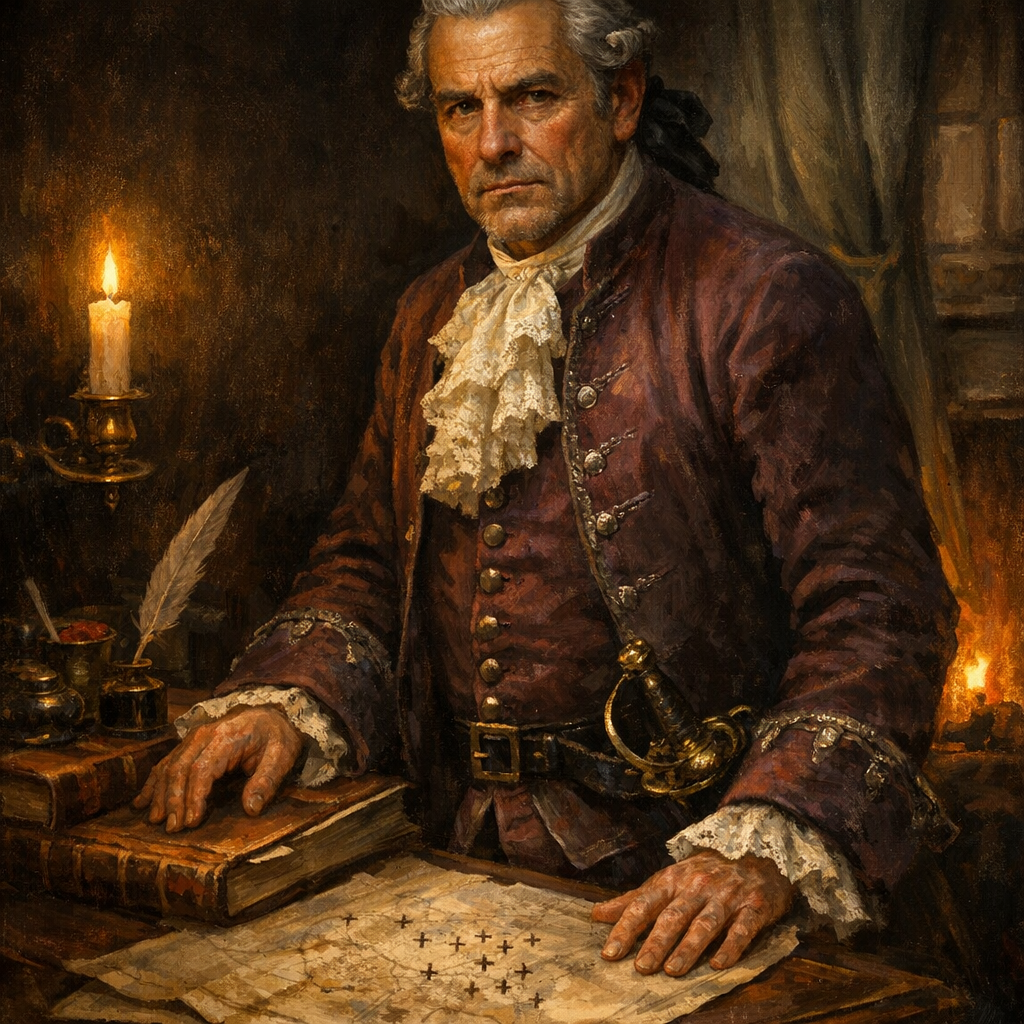
A patrician French magistrate in his early fifties, deep-plum justaucorps and silver thread, greying hair pulled into a small queue under a powdered wig — a man used to being obeyed, capable of grief, and, at the very end of the book, the figure who delivers the novel's most devastating moral inversion.
Role in the story
Richis enters in chapter 40 and dominates Part 3 from then on. He is the only character in Grasse who looks at the run of murdered virgins and recognizes a pattern — the killer is moving methodically toward the most beautiful girl in the city, which means he is moving toward Laure. In chapter 41, in his study by candlelight, with a parchment map of Grasse spread flat and small inked crosses scattered across one quarter of the page, he finishes the deduction the rest of the city will never make. It is the only piece of detective work in the novel and it is correct.
He flees with Laure for the coast in chapter 43, hides her at an inn at La Napoule in chapter 44, and wakes the next morning in chapter 46 to find her bed empty. The book grants him a paragraph of grief as a man, and then asks him to be a citizen — to return to Grasse, demand the killer's execution, and stand among the magistrates at the foot of the scaffold.
What happens to him at the foot of that scaffold is the book's most controversial sentence. When Grenouille uncorks the master perfume — the perfume whose keystone is Laure's stolen scent — Richis kneels, weeps, and embraces Grenouille as a son. The book's most intelligent love is the one most thoroughly overwritten by smell. Whether Süskind earns this beat is the perennial book-club argument; whether Richis is to blame for it is the second.
Personality in plain English
Patrician, deliberate, intelligent, controlled. Capable of grief; not given to display. Practical-minded — the deduction of the murderer's pattern is the only piece of detective work in the novel and it is correct. Loving father. Helpless before scent, like everyone else.
What he wants
To keep Laure safe. To pass the city's wealth and his own to his only surviving child. The book does not let him have either.
What he fears (or hides)
The exact fear he names to himself in chapter 41: that the killer is not random. He hides this from Laure for as long as he can; he hides it from Grasse entirely until the flight in chapter 43.
Key relationships
- Laure Richis — his daughter. The most vivid love-bond in the book.
- Grenouille — adversary, then — for thirty seconds at the foot of the scaffold — the man whose perfume convinces Richis that his daughter's killer is innocent. The cruelest beat in a book full of cruel beats.
- The Grasse magistrates — his peers. After the perfume's effect wears off, they pin the murders on Druot to spare themselves the embarrassment of having pardoned the actual killer; Richis is one of those whose silence permits the substitution.
Visual identity
Tall, well-built, still vigorous; carries himself like a man used to being obeyed. Salt-and-pepper hair pulled into a small queue, often beneath a small powdered grey-white wig for civic functions. Cleanshaven; a lined face weather-marked from Provençal sun, strong jaw, watchful intelligent eyes. In civic mode: a deep-plum or charcoal justaucorps coat with subtle silver-thread embroidery, matching silk waistcoat, knee breeches, cream silk stockings, polished black buckle shoes, full lace jabot at the throat. In domestic mode: a plain silk waistcoat, hair tied in a simple queue, no wig. In travel mode: heavy dark wool cloak, riding boots, sword at the hip, leather travel valise. The defining image is Richis at his study desk by candlelight, the map of Grasse spread flat in front of him, inked crosses marking the murder locations — the patrician at the moment of his correct deduction.
Aliases
The following names and references in the book all point to this character. Use any of these as link anchors back to this page.
- Antoine Richis (canonical — the most common form)
- Richis
- Monsieur Richis
- The second consul
- The second consul of Grasse