
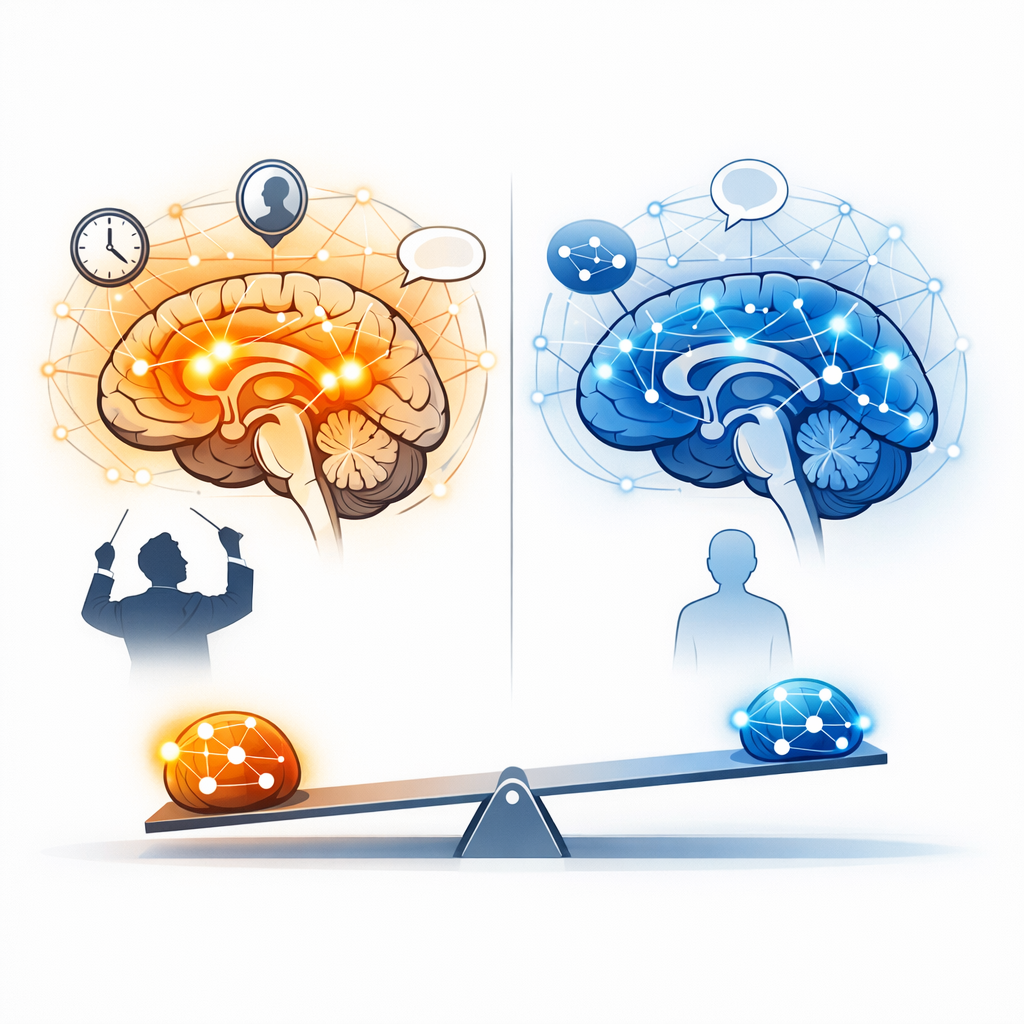
Default Mode Network
The Default Mode Network
TL;DR: The brain's ego machine — the neural network that generates self-referential thought, rumination, and the narrative "I" — and the book's central antagonist: the thing that gets quieted when the healing happens.
Spoiler-light. Covers the DMN as explained throughout the book.
Snapshot
The Default Mode Network (DMN) is a set of interconnected brain regions — including the medial prefrontal cortex and posterior cingulate cortex — that becomes active when we're not focused on a specific task. It generates our inner monologue, our mental time travel (rehearsing the past, simulating the future), our social cognition, and the continuous construction of the self-narrative: "this is who I am, this is what I think, this is what I want." It is, in the book's framing, both what makes us human and what makes us stuck.
Role in the story
The DMN is the neurological anchor for the book's entire argument. It explains why psychedelics work therapeutically: they suppress DMN activity, temporarily quieting the ego machine that maintains our mental prisons. It explains why meditation and psychedelics produce similar experiences: both deactivate the same network. It explains why depression, addiction, and OCD are disorders of excessive order: they're conditions where the DMN has locked into rigid, self-reinforcing loops. And it explains what "ego dissolution" means at the level of neural tissue — not metaphor, but measurable blood flow.
What it does
Robin Carhart-Harris and David Nutt's fMRI research produced a counterintuitive finding: psilocybin doesn't activate the whole brain as expected — it decreases activity, specifically in the DMN. The deeper the suppression, the more complete the ego dissolution and the higher the score on the Mystical Experience Questionnaire. This is the neurological correlate of the experiences mystics have described for millennia: "the self goes quiet."
In ordinary life, the DMN runs constantly, filtering perception through the lens of self-interest. It is a prediction machine: it shows you not reality, but reality-as-relevant-to-you. Robin Carhart-Harris calls normal waking consciousness a "controlled hallucination." The DMN is what controls it.
What goes wrong
Depression: the DMN locked into rumination loops, replaying failures and predicting catastrophes. Addiction: the DMN narrating a fixed story ("I am a smoker; this is what I do"). OCD: rigid DMN patterns that can't be interrupted by new information. These are all conditions of excessive order — and psilocybin's therapeutic effect, in the book's account, is to temporarily dissolve that order, allow a reset, and make space for new patterns.
The paradox
The DMN is not the enemy. It is what makes a human a coherent person rather than a scattered collection of perceptions. The goal isn't to permanently suppress it — it's to loosen its grip enough that the stories it's been telling can be examined, questioned, and sometimes set aside.
Visual identity
A brain fMRI scan with the medial regions blazing warm amber — the ego machine in full operation. Then the same scan with those regions dimmed to cool blue: the psilocybin state. Thousands of new connections lighting up between networks that normally don't speak to each other.
Aliases
The following names and references in the book all point to this concept. Use any of these as link anchors back to this page.
- The Default Mode Network (canonical — the most common form)
- DMN
- Default Mode Network (without article)
- the ego machine (Pollan's informal description)
Discussion questions
- The DMN generates the narrative self — the "I" that plans, worries, and tells the story of our life. The book suggests this is both essential and a source of suffering. How do you think about that tension?
- If depression is partly a disorder of the Default Mode Network — runaway self-referential thinking — what does that suggest about the limits of talk therapy, which mostly involves more self-referential thinking?
- The book says children have immature DMNs and experience "lantern consciousness" — diffuse, high-entropy awareness. We lose this as we develop. Is that loss a tragedy, or a necessary cost of becoming a functioning adult?