
Mystical Experience
The Mystical Experience
TL;DR: The therapeutic mechanism at the heart of the book — a specific cluster of experiences (ego dissolution, sense of unity, conviction of absolute truth) that psychedelics reliably occasion, and that correlate, in clinical research, with the most dramatic and durable healing outcomes.
Spoiler-light. Covers the concept as developed throughout the book.
Snapshot
William James described it in 1902. Mystics have sought it for millennia through fasting, meditation, breathwork, and prayer. Roland Griffiths learned to measure it with a 43-item questionnaire. In How to Change Your Mind, the mystical experience is the book's central argument: that psilocybin and related compounds reliably occasion a specific, recognizable, ancient psychological state — and that this state, independently of any metaphysical claims about its source, appears to be profoundly and durably healing.
What it is
In the book's framing, a "complete" mystical experience has four marks, drawn from William James:
Ineffability — It resists adequate description in language. People describe it as ineffable not because it was blurry or confused, but because ordinary language was designed for a world with a subject and an object, and this experience dissolves that boundary.
Noetic quality — It carries a conviction of absolute truth — a sense that something has been revealed, not just felt. James called this the "curious sense of authority" that mystical states possess.
Transiency — It doesn't last. The acute experience passes in hours. But the sense of what was revealed can persist for years.
Passivity — The ego yields rather than acts. The experience happens to you, not by you.
Beyond James's taxonomy, the psychedelic version often includes: ego dissolution (the self momentarily absent), a sense of unity with all things, strong positive affect (sometimes tears, often wordless gratitude), and the persistent feeling — days, weeks, years later — that the experience was among the most meaningful of one's life.
Why it matters
The mystical experience is not merely a side effect of psychedelic therapy — it appears to be the therapy. Across every clinical application the book covers (cancer anxiety, addiction, depression), the depth of the mystical experience during the session is the single best predictor of lasting therapeutic benefit. Patients who score highest on the Mystical Experience Questionnaire show the greatest reduction in depression, the highest smoking abstinence rates, and the most profound acceptance of death.
This is the paradox the book sits with: science is producing a treatment that works through a mechanism — the mystical state — that science cannot fully explain and that has historically belonged to religion.
Visual identity
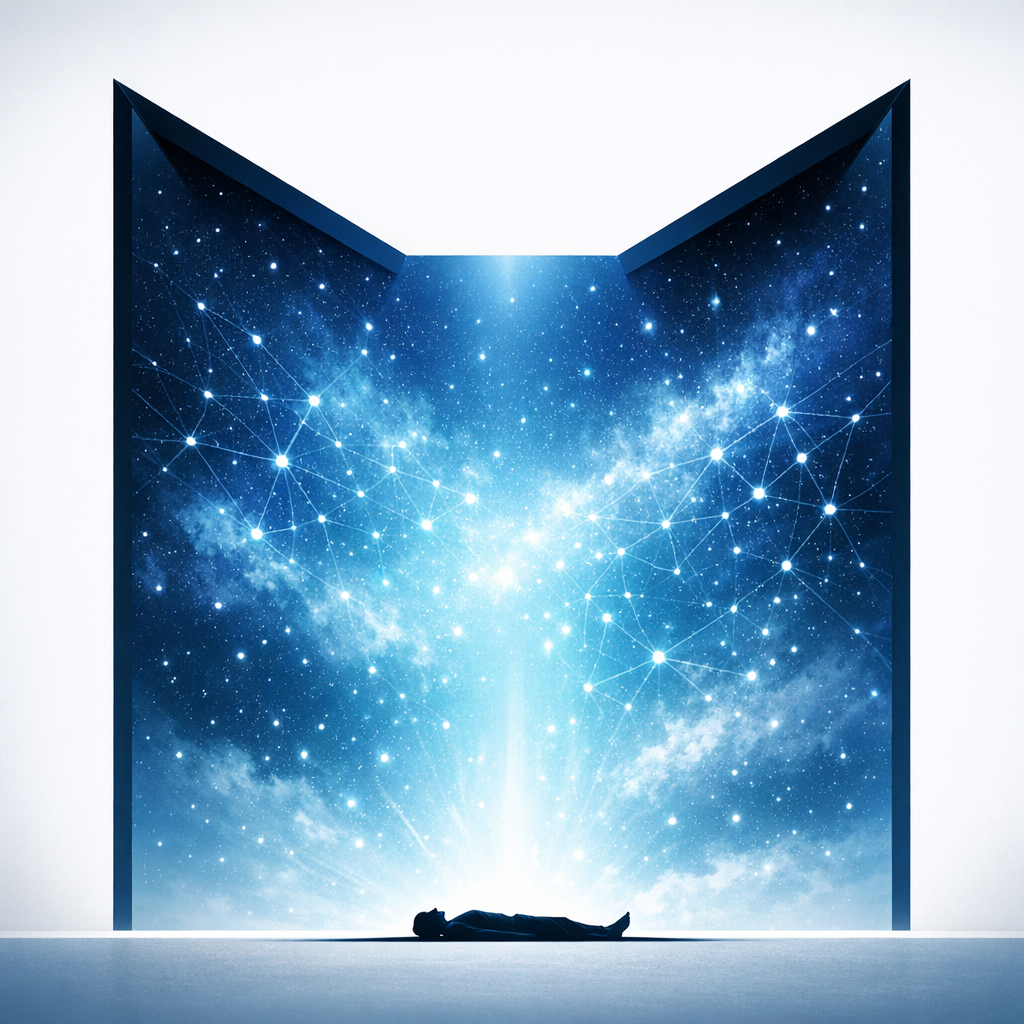
A person lying still, face peaceful, tears on cheeks. Not from sadness — from the overwhelming sense of something true. A score on the Mystical Experience Questionnaire: one red bar dwarfing all others. Light perceived from inside rather than outside.
Aliases
The following names and references in the book all point to this concept. Use any of these as link anchors back to this page.
- The Mystical Experience (canonical — the most common form)
- mystical experience (lowercase common form)
- mystical-type experience (research-literature phrasing)
- oceanic boundlessness (alternative phenomenological term used in research)
Discussion questions
- The book argues that the mystical experience is the therapeutic mechanism — not just a pleasant side effect. What are the implications for medicine if the most effective psychiatric treatments work through states that can't be fully explained?
- William James described the mystical experience as carrying "noetic quality" — a sense of absolute truth. But is a feeling of certainty the same as certainty? How do you think about this distinction?
- The mystical experience can be induced by psychedelics, meditation, fasting, sensory deprivation, and even extreme sport. Does the path matter, or only the destination?