
Roy
Roy
TL;DR: A new reality-hacker who arrives in Leadchurch at the start of book two, becomes Martin's brief apprentice, and is then left behind when the wizards depart for Atlantis. The book deliberately leaves his backstory unresolved — readers have noticed for years and the dangling thread is part of the book's character now.
Spoiler level: full book. This page assumes you've finished Spell or High Water.
Snapshot
The newcomer who was almost a story and ended up being a hint. Roy walks into Leadchurch with a polite half-smile and the look of a man who knows more than he is saying, becomes Martin's responsibility for a few chapters, and then drops out of the book when the cast leaves for Atlantis. The hints never pay off in book two. Whether that is a future setup or a structural oversight is genuinely up for debate.
Role in the story
Roy appears in chapters two, three, and five — the Leadchurch prologue chapters. He arrives at the Rotted Stump as a new wizard requesting community, defers easily to Phillip's chairmanship, and gets handed to Martin for basic training. Martin teaches him the apparent-business doctrine, walks him through a couple of low-stakes practical spells, and notices that Roy already knows things he shouldn't know yet. When the summons to Atlantis arrives in chapter four, Roy is left behind in Leadchurch with the bare minimum of a community to settle into.
His arc in book two is intentionally incomplete. The book invests in his setup — distinguishing him from the other Leadchurch wizards, giving him a slightly-off cadence, hinting that he is hiding something — and then never circles back. Whether he is laying groundwork for a future book or is simply the casualty of the book's two-plot structure, the dangling thread is itself worth noticing.
Personality in plain English
Polite, soft-spoken, observant. Roy listens more than he talks. He answers questions when asked, but his answers run a little short — never enough information to be a lie, never quite enough to be reassuring. Martin's chapters with him are full of small moments where Martin almost asks a follow-up and decides not to.
The book never confirms what Roy is hiding, so any read of his personality has to acknowledge the ambiguity. He could be a newcomer with imposter's caution. He could be a planted agent. He could be a future antagonist whose plot got rerouted. The book is comfortable with the uncertainty, and the reader probably should be too.
What he wants
Stated: to join the Leadchurch wizards. The book does not commit to whether that is the whole truth.
What he fears
The book does not show us. Whatever it is, he is good at not showing us.
Key relationships
- Martin. His brief mentor. Martin treats him with the same casual generosity Phillip showed Martin in book one — which is touching, and also a small irony, given that Roy is the one with the hidden agenda this time around, if he has one.
- Phillip. The chairman who admits him; their interactions are formal and brief.
- The wider Leadchurch wizards. A community he joins quietly and is left with when the cast departs.
Visual identity
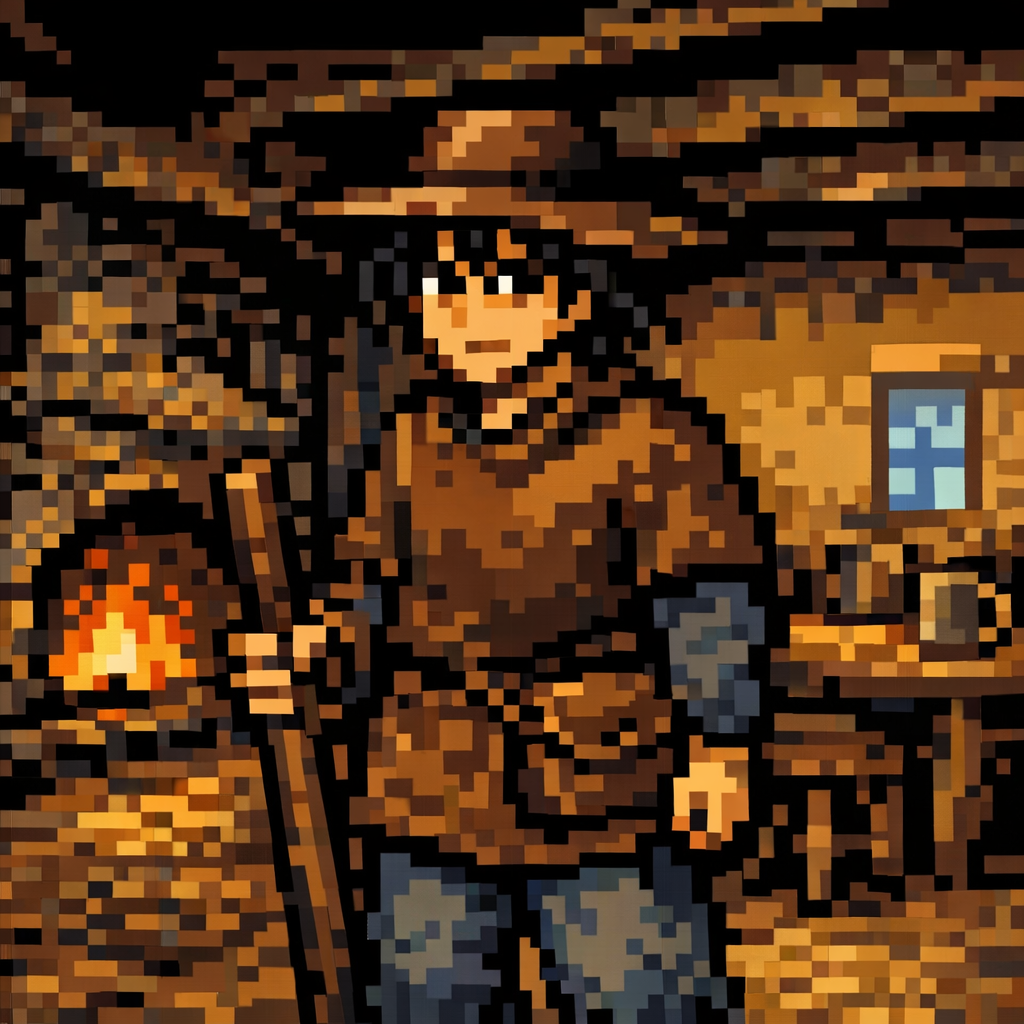
Adult man, ambiguous age. Dark untidy hair pixels in a longer, less-kept cut than the other wizards. A plain brown wool tunic over muted blue-grey trousers — newcomer clothing, hasn't yet picked up wizard regalia. A simple wide-brimmed leather hat rather than the conical wizard hats most of the fraternity wear; the hat itself signals "not yet one of us." Plain leather boots. He carries a blank wooden practice staff with no glowing orb at the tip — he hasn't earned that yet. The defining sprite detail is the expression: a faint half-smile that could be friendly or could be hiding something, slightly oblique eye-line that catches the viewer at an angle. The deliberate ambiguity is the canonical visual gesture for him.
Aliases
The following names and references in the book all point to this character. Use any of these as link anchors back to this page.
- Roy (canonical — the most common form)
Discussion questions
- Roy is one of the most carefully introduced characters in book two and one of the least developed. Does the book earn the dangling thread, or is it a structural flaw?
- The book is comfortable leaving Roy ambiguous. Are you?
- Martin is the right person to train Roy in some ways and the wrong person in others. Where does the book lean?
- Compare Roy's arrival in Leadchurch with Martin's arrival in Leadchurch in book one. What does the parallel ask us to expect — and how much of that expectation does book two cash?
- If you were writing book three, what would you do with Roy?