
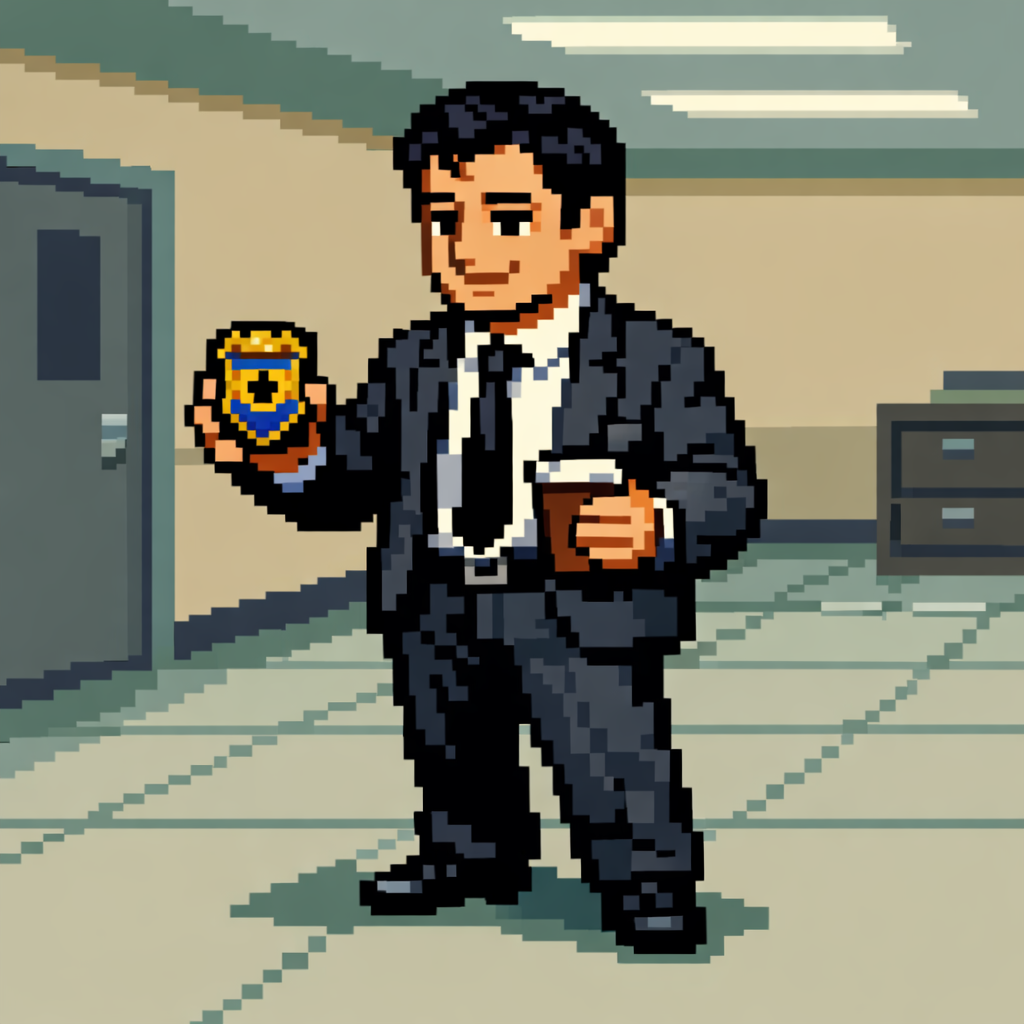
Agent Murphy
Also known as: Agent
Agent Murphy
TL;DR: The more talkative half of the Treasury duo working the financial-crime case that leads them — without their knowing it — straight to Jimmy. Wry, observant, and the one who tries to make a joke when a joke can land.
Spoiler level: full book. This page assumes you've finished Spell or High Water.
Snapshot
Miller's partner and counterpoint. Where Miller is contained, Murphy is relaxed. Where Miller takes notes, Murphy makes asides. The book uses the contrast for procedural comedy without ever shorting Murphy on competence — he is the half of the duo who notices the human texture of the people they interview, which turns out to be the half of the job that matters.
Role in the story
Murphy carries roughly half of the modern-Seattle B-plot alongside Miller. He is introduced with Miller in chapter fifteen, joins the chapter-eighteen sit-down with Jimmy, and is present for the chapter-twenty-nine wrap. The book treats him as Miller's equal — same authority, same case responsibility — but distinguishes him through register. He is the one who chats with the building clerk, who notices Jimmy's body language, who comments on the texture of the parking garage at night.
His arc, like Miller's, is the gentle deflation of a competent professional. The federal angle resolves without either of them quite catching Jimmy out, which the book treats as a fair outcome for both sides: Miller and Murphy did their job; Jimmy did his.
Personality in plain English
Wry, observant, sociable. Murphy is the agent who makes contact with people. He has the kind of warmth that gets witnesses to keep talking. He likes coffee. He gets the joke before it lands. He is also the one who is more likely to push when something doesn't add up, and Miller listens to him when he does.
The book never tells us whether Murphy suspects more than he says. There are at least two scenes — the chapter-eighteen Jimmy sit-down, the chapter-twenty-nine office-lobby resolution — where Murphy's reaction is just ambiguous enough that the reader can read it as having clocked something. Whether the book agrees is left open.
What he wants
To close the case. To do interesting work with a partner he likes. To get something more than coffee for lunch.
What he fears
The book does not show us directly. By contrast with Miller's framework-anxiety, Murphy's worry seems to be smaller and more interpersonal — being wrong about a person, missing a tell, letting Miller down.
Key relationships
- Agent Miller. Partner; the book's clearest working professional friendship. They have each other's rhythms memorized and the comedy reliably comes from their differences without ever undermining their competence.
- Jimmy. "Cooperative" expert; Murphy is the agent who is more likely to read his body language. Whether he reads it correctly is one of the book's quiet open questions.
- Todd Douglas. Person of interest; Murphy is present for the early chapter-fifteen encounter.
Visual identity
Adult man, mid-30s apparent age. Dark hair pixels with no silver — a deliberate younger-looking contrast to Miller's silver-temple. Clean-shaven, slightly wry expression. Same working federal-investigator uniform as Miller — a charcoal-grey suit jacket over a plain white dress shirt, plain dark tie — but the wear of it reads slightly more relaxed: jacket sometimes unbuttoned, tie a notch looser, a take-out coffee cup or a smartphone in his free hand. Federal Treasury badge clipped to belt. Sprite-pose is slightly off-center compared to Miller's straight-on stance — leaning, gesturing, mid-sentence — to signal the "Watson" half of a Holmes-Watson duo at sprite scale. Same settings as Miller (federal office hallway, interview room, Seattle parking garage at night).
Aliases
The following names and references in the book all point to this character. Use any of these as link anchors back to this page.
- Agent Murphy (canonical — the most common form)
- Murphy
Discussion questions
- Murphy is the half of the duo who notices people. Is he therefore the one most likely to figure out Jimmy — or the one most likely to give Jimmy a pass on instinct?
- The book leaves Murphy's reactions to Jimmy ambiguous. Does that ambiguity feel earned or evasive?
- Compare Murphy's reading of Jimmy with Phillip's reading of Martin in book one. Both are senior figures sizing up a younger man who is hiding something. Where do their methods overlap?
- The book gives Murphy noticeably more dialogue than Miller. Why?
- If a future book gives Miller and Murphy a second case, what would you want them to be looking for?