
Chapter 50
The chapter in one sentence
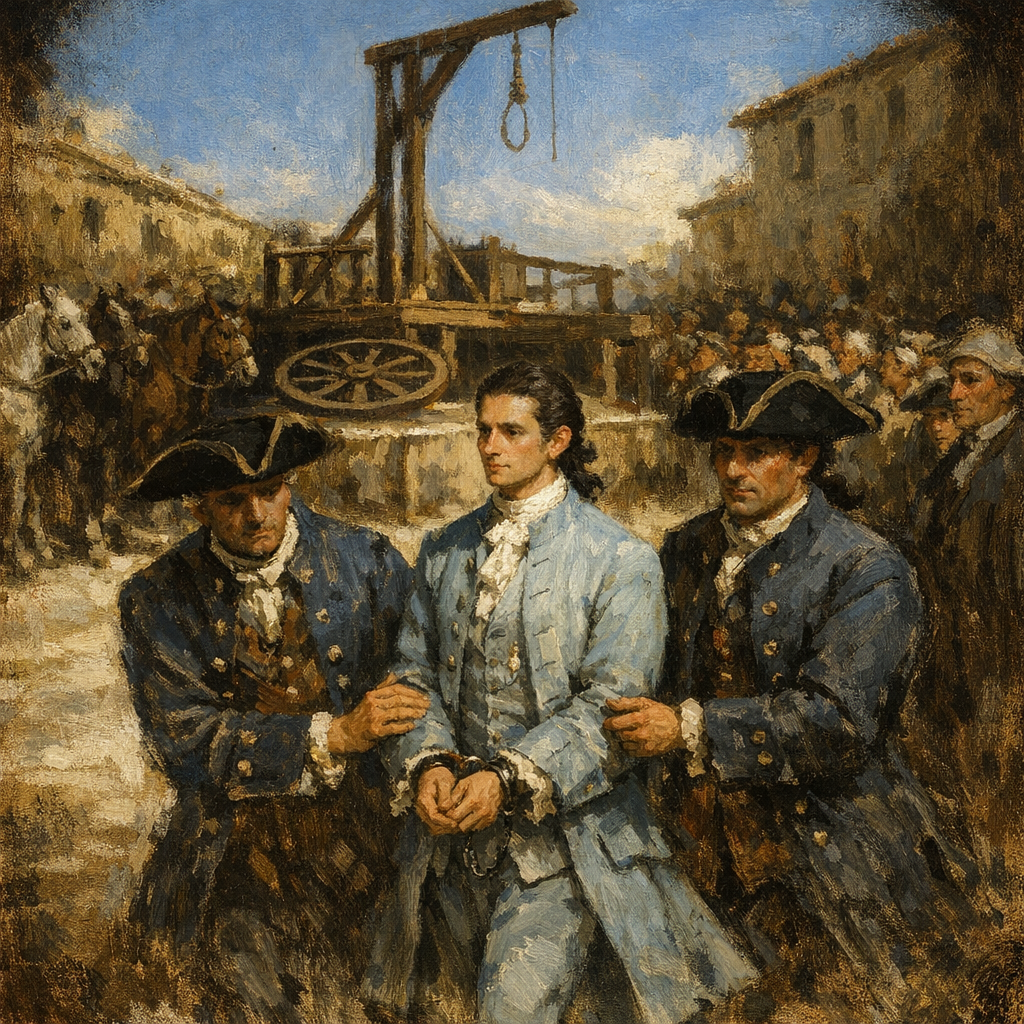
TL;DR: Under a brilliant Provençal morning sky, Grasse gathers in the Place du Cours for Grenouille's quartering — and the prisoner is led from his cell, silent and self-possessed, in clean prosecution-issued blue silk, with a tiny stoppered crystal vial hidden in the lapel of his coat.
Spoilers through Chapter 50. The vial.
The chapter walks the protagonist toward his execution and quietly shows you the small object that is going to overturn it.
What happens
The Place du Cours, mid-morning. The main civic square paved in pale worn limestone, a wooden scaffold raised at center with a hangman's gibbet, an executioner's wheel laid horizontally on a low platform, four restless harnessed horses bridled and held by stable-hands. A massed crowd of Grasse townsfolk pressed back to the edges of the square. A hard blue Provençal sky filling the upper third of the frame.
Grenouille — clean, hair tied back in a small simple queue, in a fresh light-blue silk coat and waistcoat over a fine white linen shirt with lace at the throat and cuffs, polished black buckle shoes (the prosecution's costume, intended to render him respectable for the gallows) — is led from a side gate by two civic guards in blue coats and tricorns, hands manacled in front of him. His expression is serene. The narrator notes, in a single sentence, the small stoppered crystal vial hidden in the lapel of his coat — the master perfume of the entire campaign, distilled and bottled and now, by some means the chapter does not pause to explain, in the protagonist's possession on the scaffold.
At the upper-right edge of the square, just visible: Antoine Richis among a small group of magistrates near the front of the crowd, face stricken, watching the prisoner walk to his death.
Key moments
- The walk. Grenouille between two guards, dressed for his own funeral in the town's blue silk.
- The vial. Süskind names it. The reader registers what the town does not.
- Richis's face. The chapter's grace note. A father bearing witness to a punishment he supposes will mean something.
Character shifts
Grenouille has, in this chapter, made his last calculation. He is on the scaffold by his own consent. The vial in his coat is the entire counter-argument. Richis has come to watch his daughter's killer die. He has not been told what is about to happen instead.
Why it matters
The chapter is the book's most loaded build-up. Every previous chapter of Part 3 has been working toward this Place du Cours. Süskind has been preparing the reader since chapter 9 to expect that the perfume Grenouille is making is going to be used — and the reader, on the morning of chapter 50, has been given the man, the costume, the square, the crowd, and the small stoppered vial that will make everything that comes next possible.
Themes to notice
- The artist as monster, the monster as artist — the artist on his stage.
- Worship as the most dangerous reflex — being prepared, in plain sight, by a small glass flacon nobody else can yet smell.
Book club questions
- Süskind names the vial in the lapel without explaining how it got there. Does the gap matter to you? Does it feel like cheating, or is it part of the chapter's deliberate suspense?
- Grenouille is dressed in clean light-blue silk for his execution. The costume is the prosecution's choice, intended to make him look respectable. What is Süskind doing with the irony?
Visual memory hook
A small dark figure in a clean light-blue silk coat being led across a hard sun-struck Provençal civic square by two guards in blue coats and tricorns toward a wooden scaffold, an executioner's wheel laid flat, four horses restless beside it — and a tiny stoppered crystal vial visible in the lapel of his coat, almost too small to register.
What's next
Chapter 51 uncorks it.