
Chapter 26
The chapter in one sentence
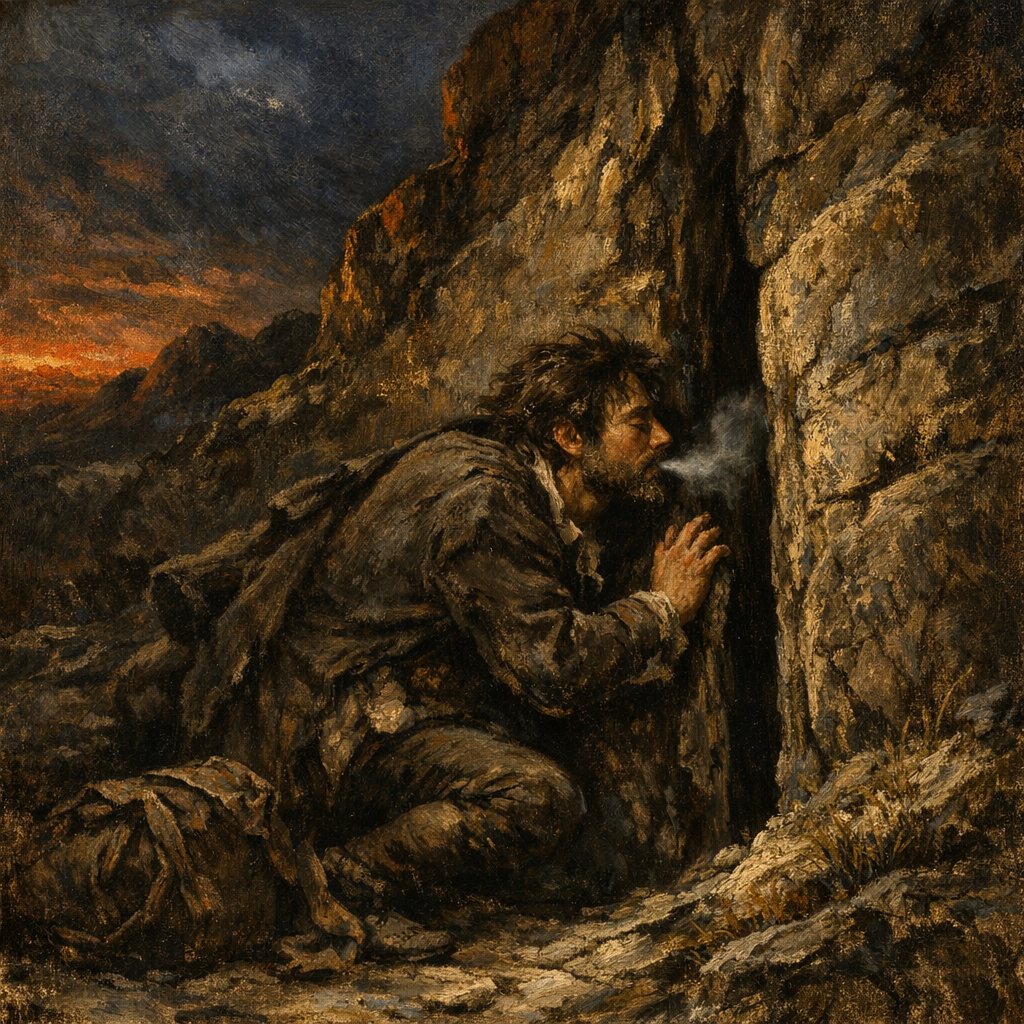
TL;DR: Grenouille finds a narrow-throated cavern high in the volcanic mountain, squeezes through the cleft into its lightless interior, and withdraws there to live like a burrowed tick — exulting in the absence of human scent.
Spoilers through Chapter 26.
The protagonist enters the geometric center of his life: a narrow stone slit in the most uninhabited place in France.
What happens
Grenouille scent-hunts along the volcanic ridge for a place that smells of nothing. He finds a hairline cleft exhaling cold stone — a vertical slit in the rock, just wide enough for a small body. He squeezes through and works his way deep enough that no daylight reaches him. The chamber at the bottom is wet, narrow, dark, sheltered, and entirely odorless.
He establishes a bed of moss and rags. He sets out the meager rations he can scavenge from the slopes. He composes himself. The chapter ends with Grenouille curling into the dark, registering the absence of every human signal in his sensory range, and being, the prose suggests, almost happy.
Key moments
- The cleft. A small vertical slit in basalt — the threshold of his hermitage.
- The squeeze. He fits through; the species he is escaping wouldn't.
- The chamber. A small bed of moss in absolute dark.
- The composure. No fire, no lamp, no ceremony. He has arrived.
Character shifts
Grenouille performs the cleanest cut of his life: from the species, from the road, from the open country. He will be in the cave for seven years, by chapter-27 reckoning.
Why it matters
The cave is the book's most sustained image of what Grenouille wants: to be alone, in the dark, in a place that does not register him because there is no one to do the registering. The horror of chapter 28 will be what happens when his wish is too completely granted.
Themes to notice
- Identity as something you have to make for yourself — and the limit-case of that project: a man who has subtracted every input.
- Smell as the sense reason can't argue with — the absence of stimulus also has a moral logic.
Book club questions
- The cave is a real geography in the book — basalt, cleft, chamber. Süskind insists on the literal physics. Why not stage the hermitage in a more dreamlike register?
- Grenouille's hermitage costs him nothing visible. Is the book asking the reader to envy the retreat? Or to fear it?
Visual memory hook
A high volcanic ridge in last light, a hairline cleft in the rock exhaling cold dark air, a small ragged figure on his hands and knees at the cleft's mouth — already disappearing.
What's next
Chapter 27 stays inside the cave for seven years.