
Chapter 25
The chapter in one sentence
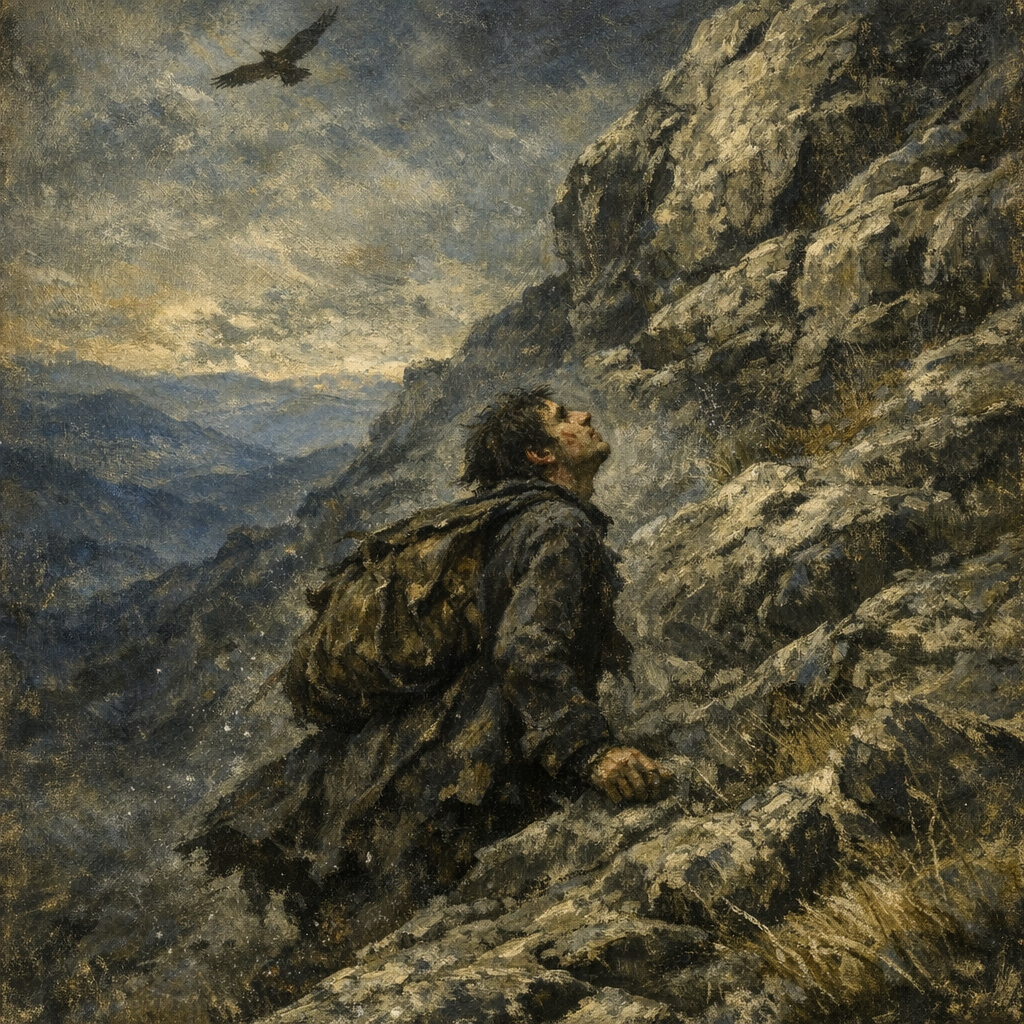
TL;DR: Grenouille triangulates by smell across the Auvergne mountains until he locates the Plomb du Cantal — an extinct volcano in the most uninhabited region of France — and prepares to seal himself inside it.
Spoilers through Chapter 25.
The protagonist arrives at the most uninhabited point in France by following the absence of human signal.
What happens
Grenouille is now navigating entirely by what he doesn't smell. He climbs the windswept volcanic slopes of the Auvergne, avoiding the few shepherd-paths and farms he registers in the distance, stopping when the air becomes mineral and clean and empty. The Plomb du Cantal — an extinct volcano in the deep middle of France, in 1750s population terms about as far from a town as one could practically get — rises in front of him.
He stands on the ridge with the cold high wind moving over scrub and basalt, a hawk on a thermal in the upper sky, and registers what he has been looking for. There are no people for miles. The silence is not metaphorical; it is, to his nose, literal. He has found his place.
Key moments
- The triangulation. Grenouille reading the wind for human signal — and noting its diminuendo as he climbs.
- The summit. A small ragged figure against the scale of a volcanic massif. Süskind grants the moment a beat.
- The decision. Implicit. He will go up and he will not come down for a long time.
Character shifts
Grenouille has crossed the threshold from withdrawal to retreat. The next chapter will give the cave; this one gives the country.
Why it matters
The chapter is the geographic deepest point of Perfume. From here forward Grenouille will move back toward people — first the Marquis, then Grasse, then the scaffold, then Paris. The book's structural shape is a long descent followed by a long return; chapter 25 is the bottom of the U.
Themes to notice
- Identity as something you have to make for yourself — by removing every other identity-input.
- Pre-Revolutionary France as a body that knows it's rotting — Süskind's geography of human absence is the book's only Eden, and it is uninhabitable.
Book club questions
- Süskind grants the protagonist a successful escape from the species at this exact midpoint of the book. What does the book think he has won?
- The Plomb du Cantal is a real place. Why an extinct volcano in particular?
Visual memory hook
Bare grey-black volcanic stone, mossy basalt outcrops, scrub vegetation, no trees, a cold high wind suggested by the angle of clinging weeds, a small ragged figure climbing the ridge against the scale of the mountain.
What's next
Chapter 26 puts him inside it.