number-one-mental-problem
The Number One Mental Problem (Over-Trying)
Concept-character. Rendered as an editorial infographic, not a figure portrait, per the non-fiction adaptation.
Name
- Canonical: The Number One Mental Problem
- Aliases: Over-trying, "trying too hard," conscious-takeover, the choke mechanism
Role in the system
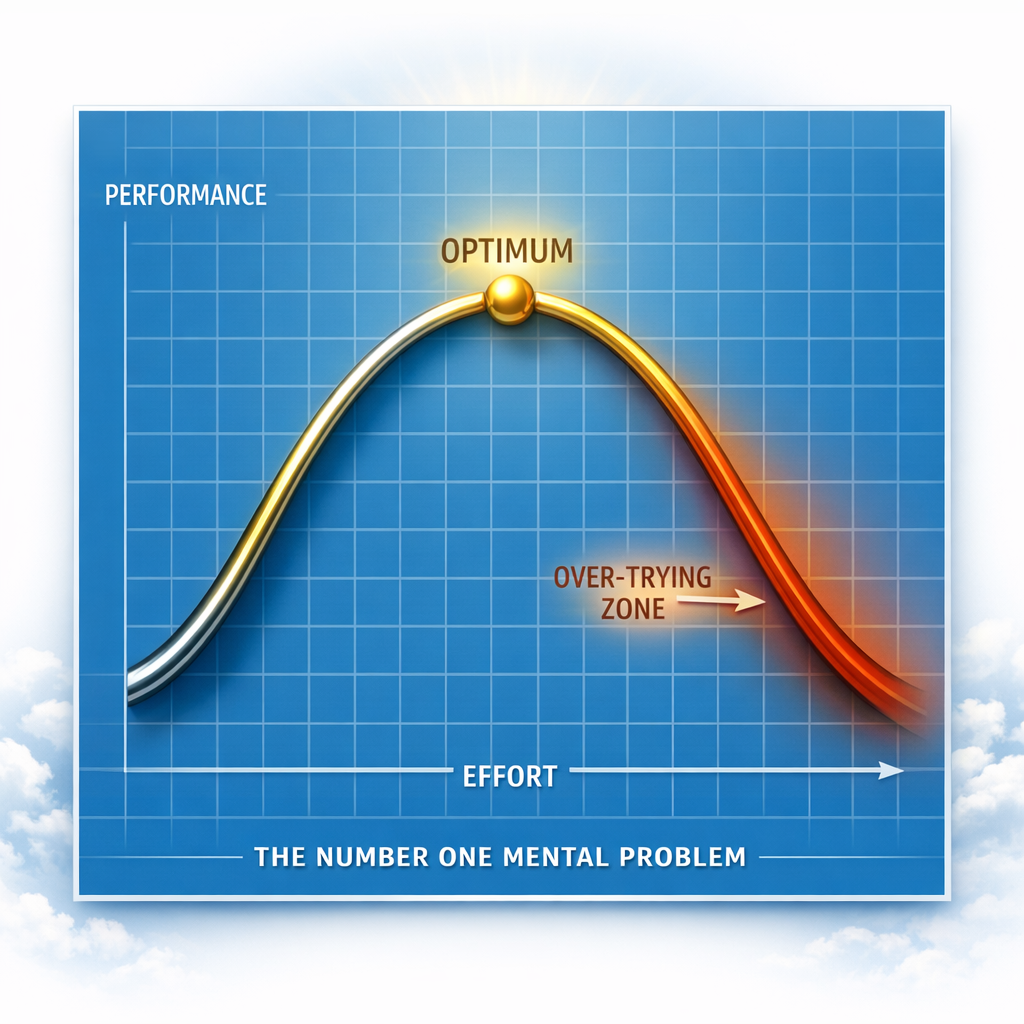
The Number One Mental Problem is Bassham's named diagnosis of the most common failure mode under pressure: when a performer tries harder, the Conscious Circle muscles into a slot reserved for the Subconscious Circle and disrupts the automatic skill-pattern that the Program is supposed to deliver. Performance drops because effort rises. Bassham's claim — and his name for this — frames it as the singular dominant failure mode in skilled execution: not lack of skill, not lack of preparation, but the conscious mind helping when it should step out of the way. The antidote is not "try less" (which is also conscious) but "run the Mental Program" — the Program is the structured handoff from Conscious to Subconscious.
Personality / energy ("functional behavior")
- Counter-intuitive — increasing effort decreases performance past an optimum.
- Self-reinforcing — bad reps trigger more trying, which produces worse reps.
- Pressure-amplified — over-trying gets worse as stakes rise.
- Treatable only by handoff — the fix is running the Program, not trying less (which is itself conscious).
- Universal — applies to every skill domain: athletics, music, public speaking, surgery, sales calls.
Physical description ("visual representation")
A premium inverted-U performance curve plotted on a clean cerulean grid, rendered in hyperreal CGI as an editorial data-graphic. The X-axis (along the lower edge) is labeled EFFORT in small white sans-serif; the Y-axis (along the left edge) is labeled PERFORMANCE. The curve rises smoothly from the lower-left, peaks at a small luminous gold marker labeled OPTIMUM, then descends into a warning-tinted zone that fades from gold to a muted warm red-amber at the right edge. A small annotation arrow at the descending side reads "OVER-TRYING ZONE." The entire composition reads as a clean Yerkes-Dodson curve — a known scientific shape, premium-rendered.
Outfit / clothing notes ("secondary visual elements")
- Cerulean grid background (faint, scientific).
- Inverted-U curve in a chrome-to-gold gradient with a luminous gold OPTIMUM marker at the peak.
- Right-side descent fading into muted warm red-amber.
- "EFFORT" axis label, "PERFORMANCE" axis label, "OPTIMUM" peak label, "OVER-TRYING ZONE" descent annotation.
- Small white sans-serif title "THE NUMBER ONE MENTAL PROBLEM" along the bottom edge.
Visual motifs
- Yerkes-Dodson inverted-U as the canonical scientific shape.
- Cerulean grid (Conscious-mind tone) — the Conscious Circle is the actor running too hot.
- Gold optimum point — the Self-Image-aligned sweet spot.
- Warm red-amber descent — visual warning zone, restrained, not cartoonish.
- Premium scientific-graphic polish — Visual Capitalist / 538 / Bloomberg-style editorial chart.
Magic / power signature ("signature mechanic")
The performance-effort inversion. Render the descending side of the curve with a faint downward "drag" shadow, communicating the cost. The OPTIMUM marker glows softly. Annotation arrow on the descent has a subtle warning shimmer.
Chapter appearances
- Ch 11 — Number One Mental Problem (full chapter — feature appearance)
- Ch 9 — Running a Mental Program (the Program is the antidote)
- Ch 10 — Pressure (over-trying is the most common pressure response)
- Ch 12 — The Skills Factory (training designed to make Programs robust enough to absorb pressure without over-trying)
Source references
- https://www.robrashell.com/thelibrary/books/withwinninginmind/ (over-trying as the No. 1 mental problem)
- https://www.lucasballasy.com/posts/blt-no-134-7-mental-management-principles-from-with-winning-in-mind-by-lanny-bassham (over-trying labeled and discussed)
- https://whatgotyouthere.com/with-winning-in-mind-by-lanny-r-bassham/ (counter-intuitive effort/performance relationship)
Confidence
Medium-high — Bassham's "Number One Mental Problem" framing of over-trying is well-attested, but the primary chapter 11 article is paywalled in some sources; the diagnostic framing is consistent across reader summaries.