
Chapter 4
Chapter 4 — The Balance of Power
Section: One — What is Mental Management?
1-sentence summary
Sustainable peak performance requires the three circles to grow together — when one outpaces the others (most often Conscious knowledge racing ahead of Subconscious skill or Self-Image), stress, frustration, and choking are the symptoms.
Summary
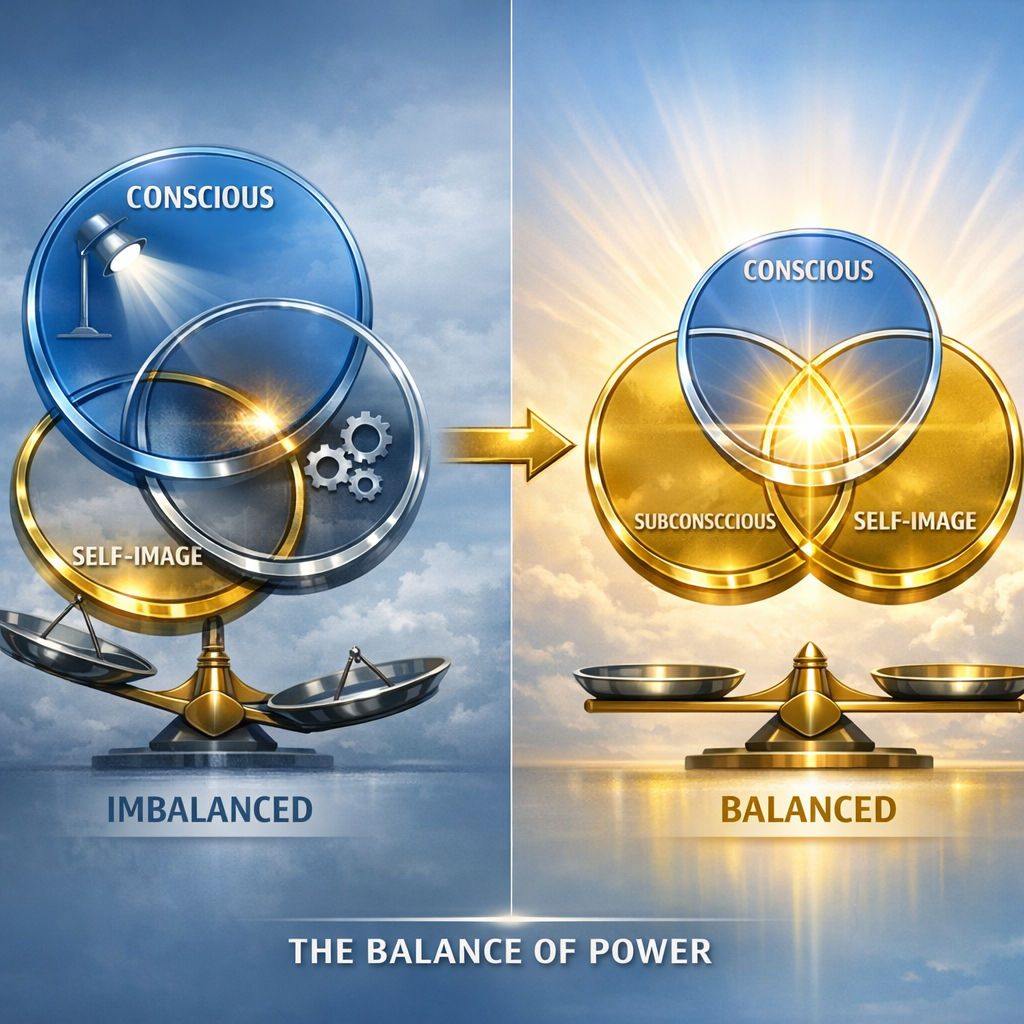
Bassham's central diagnostic image: imagine the three circles as equally sized rings. When all three are equal, you're in balance and performance feels effortless. When you "study up" without practicing, your Conscious Circle grows but your Subconscious does not — you know what to do but can't make your body do it under pressure. When you train hard but never update your Self-Image, performance ceilings out — you hit a number and then fall back to where Self-Image says you "belong." The work, therefore, is to grow all three rings in parallel: read and learn (Conscious), drill and rehearse (Subconscious), and reshape your story of who you are (Self-Image). This sets up the structure of the rest of the book: Section 2 builds the Conscious Circle, Section 3 builds the Subconscious Circle, Section 4 builds the Self-Image Circle.
Key scenes
- The three-rings diagram, drawn in equal vs. mismatched sizes to show imbalance vs. balance.
- An athlete who knows the technique cold but can't reproduce it under tournament lights — Conscious > Subconscious imbalance.
- An athlete whose Self-Image hasn't caught up to a personal best — they revert to the old number next outing.
"Characters" referenced (concepts)
- All three circles (CM/SC/SI)
- The framework itself (Three Mental Processes)
- The imbalance pattern (a named diagnostic, not a tool)
Locations / settings
Conceptual — diagram space; brief practical examples on the range / course.
Visual motifs
Three equal-radius rings overlapping in a Venn-like balance; the same three rings shown unequal, one bloated, one shrunken — visually unstable; an Olympic-style scale with three plates.
Source references
- https://www.scribd.com/document/364432776/Lanny-Bassham-With-Winning-in-Mind-3rd-Ed-Booksee-org
- https://www.coursehero.com/file/218962409/With-Winning-in-Mind-Lanny-Basshampdf/
Confidence
High — "Balance of Power" is the named chapter, and the equal-rings model is repeatedly cited.