
Chapter 16
Chapter 16 — Making the Directive Affirmation Work for You
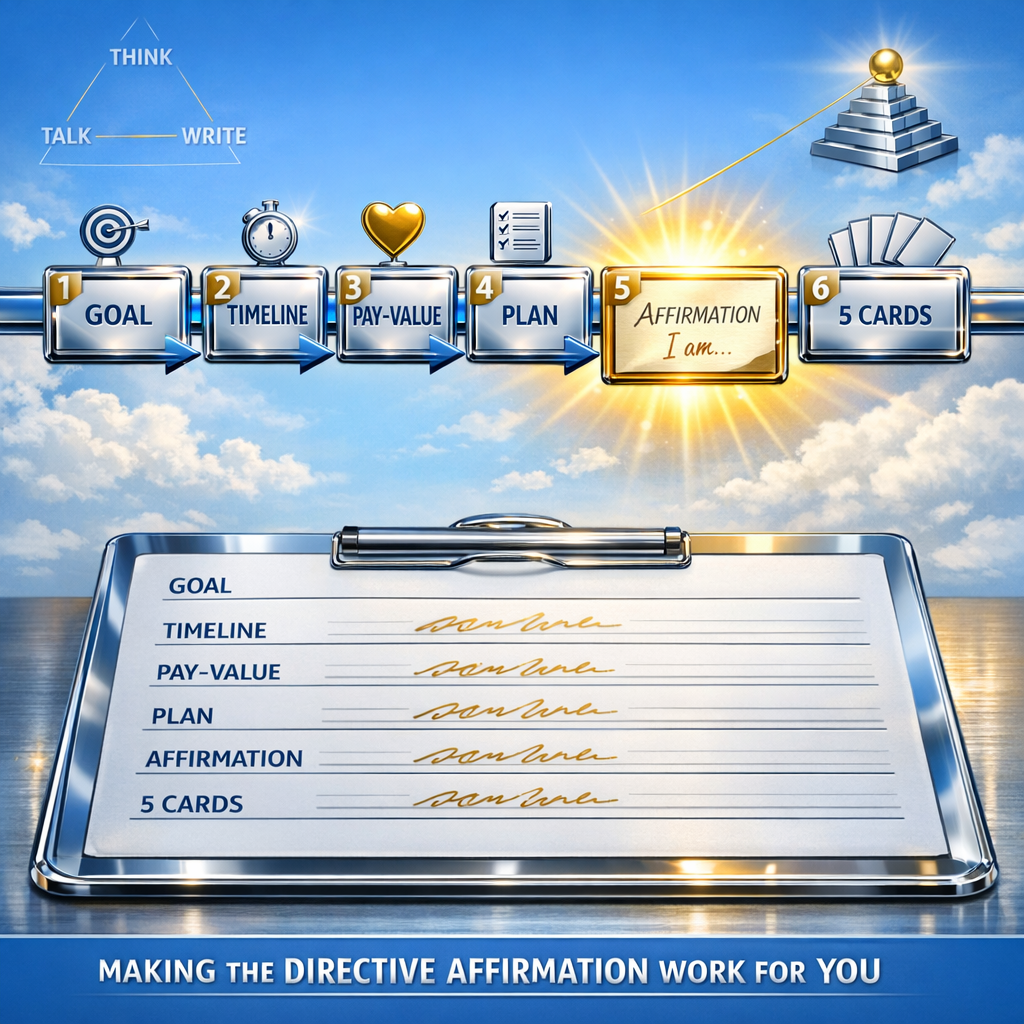
Section: Four — Building the Self-Image Circle
1-sentence summary
A practical, six-step protocol for actually deploying the Directive Affirmation in your real life — turning Chapter 15's tool into a habit you can run.
Summary
Where Ch 15 introduced what a Directive Affirmation is, Ch 16 spells out how to make one of yours work. Bassham gives a six-step framework: (1) Define the goal precisely. (2) Set a time limit / deadline. (3) List your "pay-value" — the personal reasons this goal is worth your time and energy. (4) Outline an achievement plan — the actions required. (5) Write the affirmation as a paragraph, first-person present tense, that incorporates 1–4. (6) Make five handwritten copies on index cards and place them in conspicuous locations. The chapter is the operations manual: what's recommended in the abstract in Ch 15 gets specified concretely here, with troubleshooting for common stumbles (affirmations written too vaguely, cards placed and ignored, the 21-day rhythm broken).
Key scenes
- The six-step worksheet rolling out: GOAL → TIMELINE → PAY-VALUE → PLAN → AFFIRMATION → 5 CARDS.
- A worked example — a goal turned into a complete affirmation paragraph in real time.
- Troubleshooting micro-cases: vague affirmations, ignored cards, broken streaks, recovery.
"Characters" referenced (concepts)
- The Directive Affirmation (operations manual; same character as Ch 15)
- The Mental Management Goal Setting System (Ch 5 — feeds the affirmation)
- The Principle of Reinforcement (the engine that makes the cards work)
- The Self-Image Circle (the destination)
Locations / settings
Desk / journal; the same five everyday surfaces from Ch 15 (mirror, visor, desk, gym bag, bedside).
Visual motifs
A six-panel comic strip — each panel one step; a worksheet template with six labeled fields; the five index-card placements as an exploded-view of a daily routine; a "21" calendar circle with a red checkmark every day.
Source references
- https://www.linkedin.com/pulse/winning-mind-lanny-bassham-4-minute-read-lars-christensen
- https://www.shortform.com/pdf/with-winning-in-mind-pdf-lanny-r-bassham
- https://kevinconnelly.blog/2020/09/07/book-summary-with-winning-in-mind-by-lanny-bassham/
Confidence
High — six-step framework consistent across summaries.