
Chapter 28
In one sentence
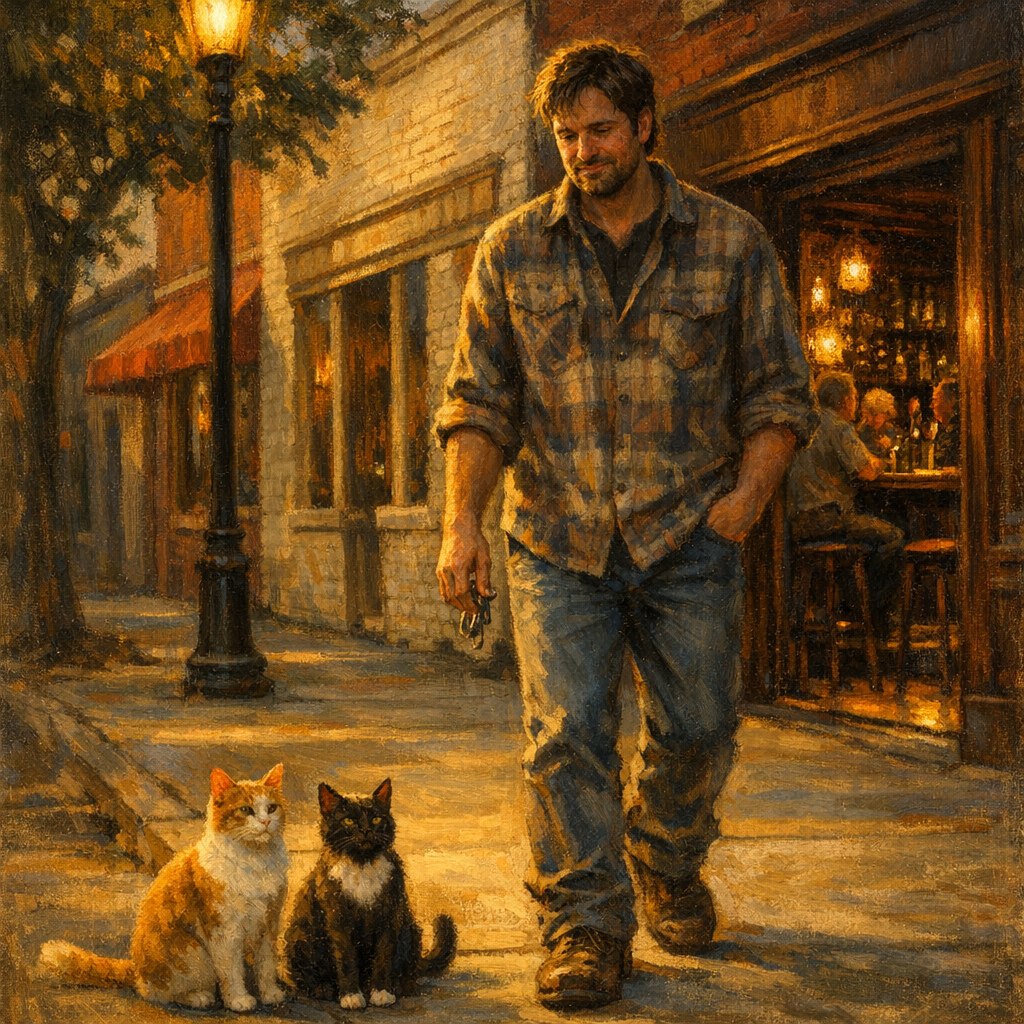
TL;DR: A year later, Charlie is back in Barrington — owner of McDougal's Pub, comfortably wealthy on Jake's bequest (Hera's house, several investments, McDougal's Pub: roughly $11.75M total) — and after closing up the pub on a quiet weeknight, he walks home through a late-summer evening and finds Hera and Persephone waiting for him on the sidewalk under a streetlamp; they greet him, and they walk home together.
Spoilers through Chapter 28 — full ending.
The book closes on the same composition it opened on — a man and a cat in domestic scale, painted with deadpan dignity — but the volume of everything around the picture has changed forever.
What happens
Twelve months on. The pub Charlie always wanted to buy in Barrington is his, paid for outright from the inheritance — Hera's house, several investments, and McDougal's Pub, totalling roughly $11.75 million. He is comfortably wealthy in the small, durable way the book has spent twenty-eight chapters arguing for. The pub is full, in the modest way Midwestern neighborhood pubs are full on a weeknight — wood, brass, beer light, regulars at the bar, the kind of room people choose because they like it rather than because they are performing. Charlie closes up. He pulls the chain on the front-window neon. He locks the door. He turns down the sidewalk under a single streetlamp at golden hour.
Hera and Persephone are waiting on the sidewalk, ears alert. They greet him at his eye-line. They walk home with him.
The book ends there. No flourish. No callback to the empire. No nod to Mathilda or Dobrev or the dolphins or the volcano. Just a man, two cats, and a Barrington street in late summer.
Key moments
- The pub interior. Beer-light on dark wood. Regulars at the bar. The small life Charlie wanted, in the form he wanted it.
- The closing routine. The chain on the neon, the keys in the lock, the breath on the air if it's already early autumn. The book lets the routine be the whole chapter.
- The sidewalk. Single streetlamp. Modest brick storefronts. Suburban trees. The book's hero light is the most ordinary light it has used.
- Hera and Persephone meeting him at eye-line. The cover painting redone in domestic key — same composure, same dignity, same composition, smaller scale.
- Walking home together. The book's last image. The novel's first sentence and last sentence are, structurally, the same sentence, and the difference is everything.
Character shifts
- Charlie has the small life he always wanted, cleanly. The book lets the ending be a gift rather than a triumph.
- Hera and Persephone have made a choice. The book is pointed: they retired and chose to come with him.
- Jake Baldwin, off-page, is more present in this chapter than he has been since the study scene in Chapter 9. The bequest is his, the cats are his, the pub money is his, the entire ending was something he engineered.
Why it matters
This is the book's quiet thesis statement. Starter Villain spends twenty-seven chapters in a Bond-villain world and ends, deliberately, on a Barrington sidewalk. The choice is the argument. Scalzi has been making the case all the way through that the most extraordinary world in fiction is just a backdrop for the most ordinary human question: what kind of life would you actually want to live? The book gives Charlie the empire and lets him give it back. The closing image — a man walking home with his cats after his shift at the pub he owns — is a refusal of the power fantasy and a vindication of the small life.
It is also, structurally, the cover painting at full scale. The cover renders an executive cat in oil-paint dignity. The closing image renders the same dignity, the same posture, the same lighting key — at the scale of a Midwestern sidewalk. The book ends by telling the reader that the cat on the cover was always at home in this composition. Both compositions are her.
The bequest matters too. The book chooses an exact number — ~$11.75M — small enough that the reader registers it as enough rather than as transformation. Charlie ends the book wealthy, but not the kind of wealthy that changes who he is. He ends with a pub, a pair of cats, and a way to live the life he was already trying to live. The book argues that this is the right ending for a man who never wanted the empire. It also argues, more quietly, that the right ending for the heir of a man like Jake is whichever ending the heir chooses. Charlie chose this one.
Themes to notice
- The small life as victory. A pub, ~$11.75M, two cats, a Barrington sidewalk. The book argues these are the right rewards.
- The cover painting completed. Hera at eye-line on a sidewalk is the cover image at human scale.
- Refusal as character. Charlie chose not to be the villain. The book lets the choice stand without speech.
- Decency as inheritance. Jake's most generous gift was a way out that didn't depend on Charlie figuring out he'd been used.
Book club questions
- The book ends on the same compositional beat it opened with — a man and his cat in domestic scale. What is Scalzi arguing by closing the loop this exactly?
- The bequest is an exact figure: ~$11.75M. Why this number? What does the precision do for the ending?
- Charlie ends with a pub, two cats, and a sidewalk. Is that a happy ending, a refusal of the empire, a quiet political statement, or all three?
- Hera and Persephone chose to come home with him. The book is pointed about the choice. What does it mean that the cats stay because they want to?
- Re-read the first chapter immediately after the last. What changed? What didn't?
- Starter Villain spends twenty-seven chapters in an extraordinary world and ends in an ordinary one. What is the book arguing about ordinary lives by giving Charlie one back?
Visual memory hook
Beer-light on dark wood — warm, intimate, perfectly ordinary. A man's silhouette in a pub doorway, lit from inside. A streetlamp at golden hour, modest brick storefronts, suburban trees. Two cats on a sidewalk meeting a man at his eye-line — the cover painting redone in domestic key.
After the book
Read the themes page next; the book's quiet political arguments — wealth as cosplay, labor as labor, decency as resistance, chosen family as inheritance — are clearest when held together. Then revisit the character pages with the long-con reveal in mind: Mathilda, Dobrev, and Hera in particular read very differently on a second pass.