
Chapter 19
Chapter 19 — "The Passage"
TL;DR: The Institute's first trial is the Passage — every student is locked in a stone chamber with one other student and told only one walks out — and Darrow is paired with Julian au Bellona, Cassius's gentle twin, whom he is forced to kill with his bare hands.
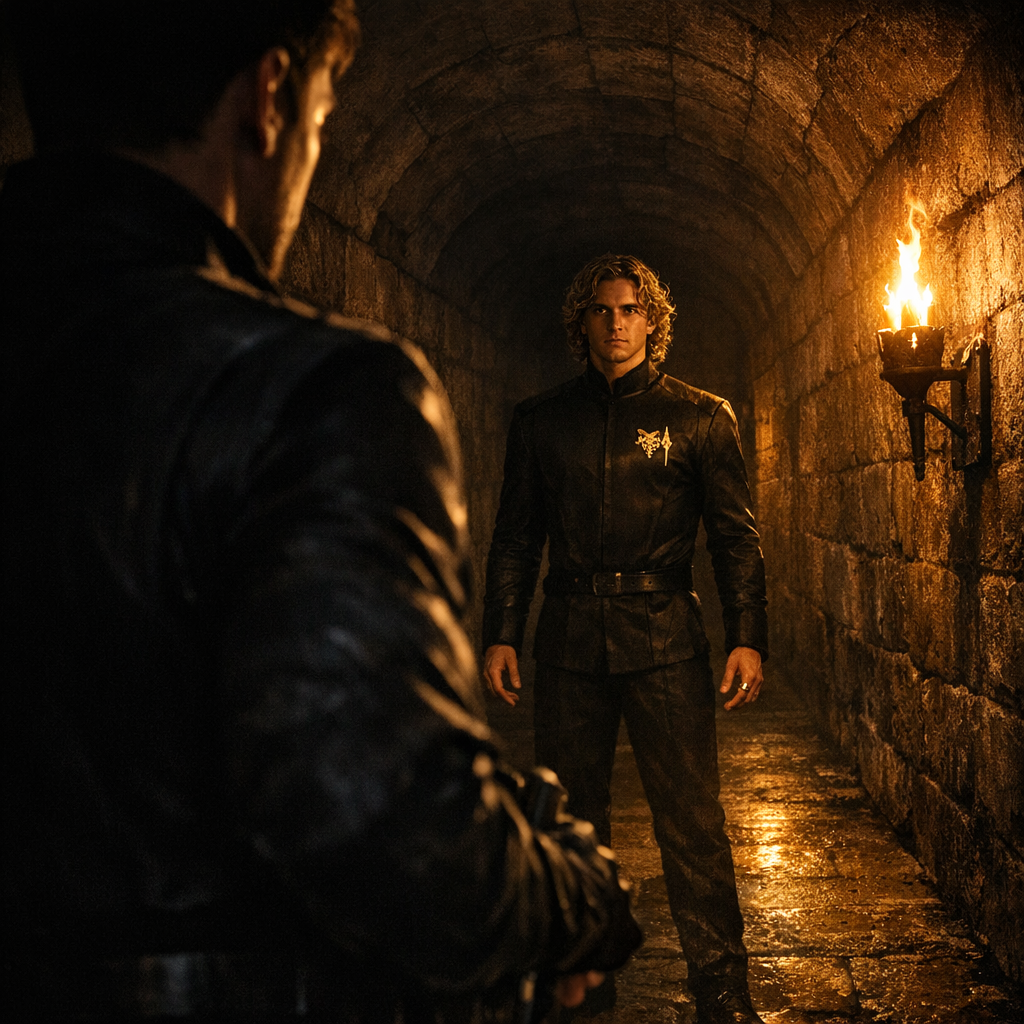
Summary: The Passage is the single most defining cruelty of the Institute. Each candidate is taken alone into a stone chamber, placed at one end of a long hall with no light but a torch, and told the chamber holds one other student. Only one of the two will be permitted to leave alive. The Proctors call it culling. Darrow's chamber pairs him with Julian au Bellona — Cassius's twin brother, the gentlest Gold Darrow has met, a boy who reads philosophy and refuses cruelty. Darrow tries to find a way around the rule; there is no way around the rule. Julian charges; Darrow disarms him; the boy will not yield. In the end Darrow strangles him with his bare hands on the stone floor. He carries Julian's body out himself. The chapter ends with Darrow stepping back into the daylight of the Institute and seeing Cassius, still smiling — Cassius does not yet know who killed his brother. The quiet horror of that future knowledge sits over Darrow for the rest of the novel.
Key scenes:
- A stone chamber, dim torchlight, a boy at the far end.
- The disarmament — razor knocked aside; Julian refusing to surrender.
- The strangulation on the floor — the chapter's most physically intimate horror.
- Darrow walking out into Institute sunlight carrying Julian.
- Cassius's unknowing smile on the steps of the amphitheater.
Characters present: Darrow, Julian au Bellona (named, killed), Cassius au Bellona (offstage end-of-chapter), Proctor Mars / Fitchner (offstage observer), other students processing through their own Passages.
Locations / settings:
- The Passage chamber — long, low, vaulted stone, single torch, no windows, no exits but the door behind each student.
- The amphitheater steps in late-day Mars sunlight — the contrast of horror just behind the door against ordinary daylight.
Visual motifs: torchlight on stone; Julian's gold-eyed face going still under Darrow's hands; the long shadow of the chamber stretched across slabbed floor; Darrow's bloodied palms and shaking arms in Mars-red sunlight; Cassius's smile on the steps — a sword waiting to fall.
Emotional tone: ceremonial horror, intimate killing, dread of the consequence to come.
Confidence: high — the Passage is one of the novel's most-cited beats.