
Jeanne Bussie
Jeanne Bussie
TL;DR: The Parisian wet nurse who refuses to keep nursing the infant Grenouille and is the first character in the book to perceive — correctly — that there is something wrong with him, even though the only language she has for it is religious.
Spoilers through Chapter 3.
Snapshot
A stout, middle-aged, plain-spoken working-class Parisian woman who has nursed many babies and knows what babies smell like. Grenouille, in her arms, smells of nothing, and she has the courage to say so out loud to a priest who isn't listening.
Role in the story
Jeanne Bussie nurses the infant Grenouille for several weeks under a paid arrangement with the cloister of Saint-Merri. Then she carries him back to Father Terrier and refuses to take him further. Her scene with Terrier is brief, comic, and profoundly correct: the priest patronizes her religious vocabulary, but the substance of what she's saying — this child has no smell of his own — is the exact diagnosis the rest of the book is going to spend 250 pages confirming.
She is the first of the book's gallery of women who perceive what is wrong with Grenouille faster than any of the men.
Personality in plain English
Practical, devout in a folk-Catholic way, stubborn under condescension. Not a sophisticated thinker, but an honest reporter. The book grants her dignity by letting her be right.
What she wants
To be paid for the work she has done, to be free of the unsettling infant, and to not be lectured about the devil by a priest who has clearly never held a normal baby.
What she fears (or hides)
Whatever the absence in Grenouille is, she fears it the way you fear something with no name. She is honest about the fear; she does not hide it.
Key relationships
- The infant Grenouille — paid charge, several weeks. She is the first nurse to last more than a few days, and the first to formally demand to be released from the contract.
- Father Terrier — her audience for the return of the child. Their scene together is a class drama: a working-class woman and an educated man, where the working-class woman is correct.
Visual identity
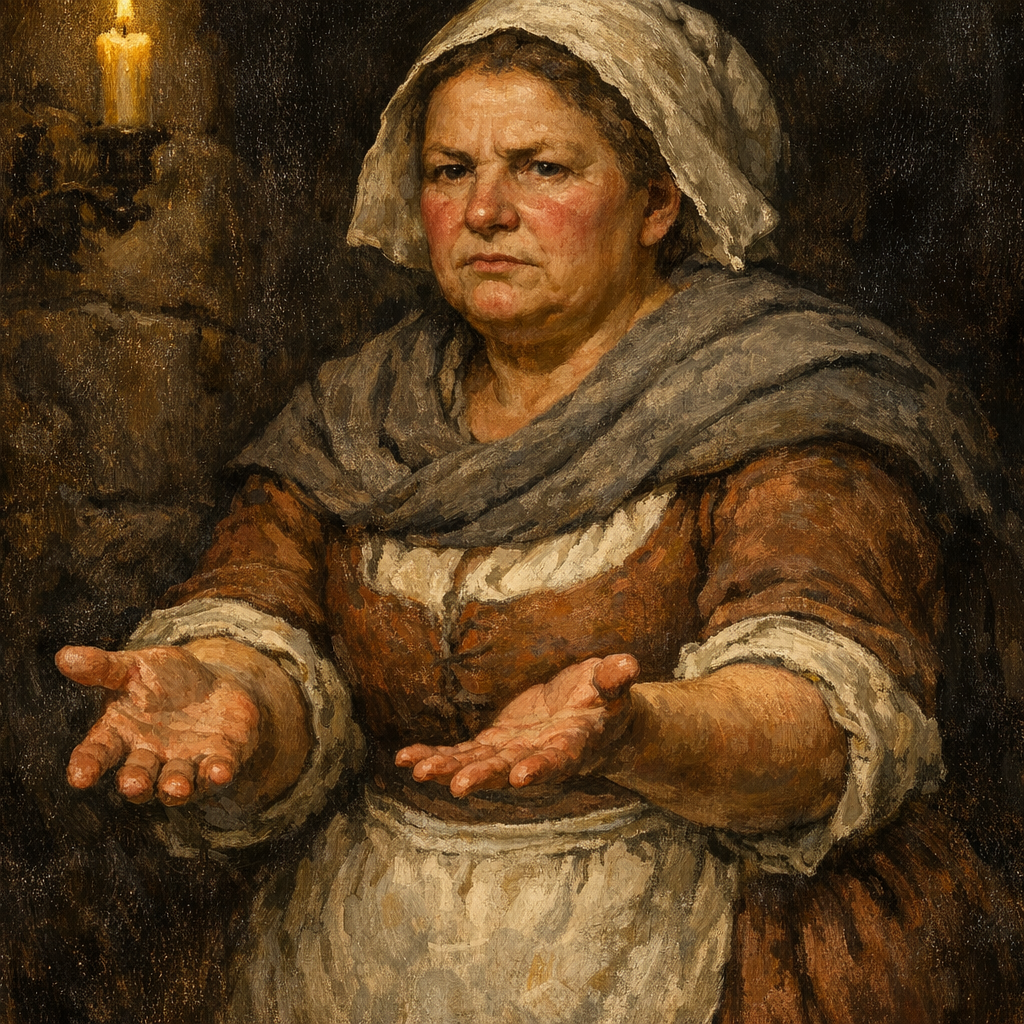
Stout, ruddy, weathered. Coarse mid-brown hair pinned under a low white linen coif with a kerchief over it. Long-sleeved coarse linen shift, heavy russet wool kirtle, much-laundered white linen apron with faint milk-stains, a folded grey wool shawl across her shoulders for the cloister scene. The defining gesture: hands held forward, arms outstretched, returning the swaddled infant. Plump capable forearms, broad work-hardened hands, chin set, mouth a flat line of conviction.
Aliases
The following names and references in the book all point to this character. Use any of these as link anchors back to this page.
- Jeanne Bussie (canonical — the most common form)
- Bussie
- Jeanne
- The wet nurse