
Chapter 6
The chapter in one sentence
TL;DR: Grenouille prowls 1740s Paris like a silent compass, building, alley by alley and market by market, the internal scent-atlas of the city that will be his only education and the foundation of every later chapter — including, as the chapter quietly notes, his evening visits to the heavy-honeyed wall of the Cimetière des Innocents.
Spoilers through Chapter 6.
Süskind pulls back from the tannery to show the protagonist's actual schooling, which is happening, unsupervised, in the streets of Paris at dusk.
What happens
Grenouille is now ten or eleven. The tannery uses him by day; the city is his at night. He walks the Right Bank, the quais, the markets, the cathedral squares, learning Paris by nose. The chapter is structured less as plot than as catalogue: each district has a signature mix — fish market, tannery, river mud, joiner's glue, candle-tallow, slaughterhouse, hot tar. He files them all.
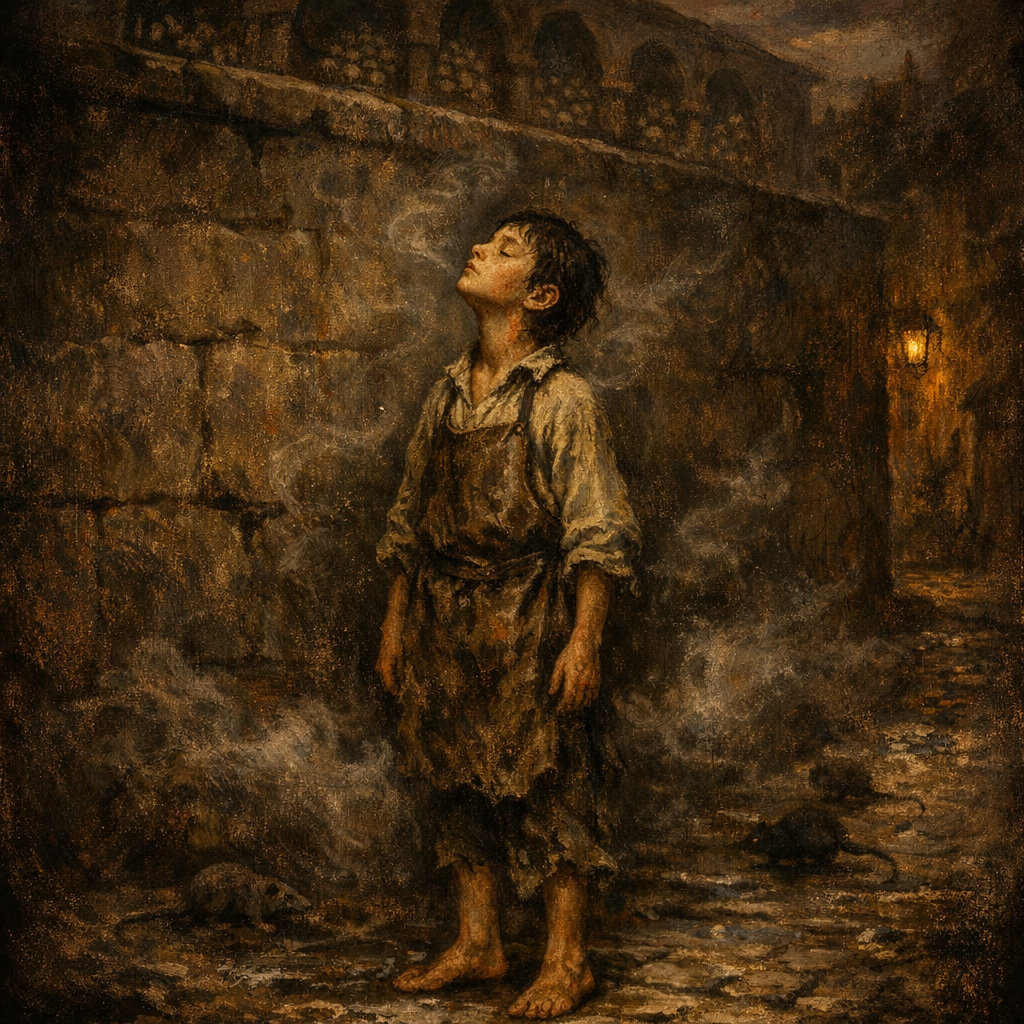
The novel's most haunting set-piece in this stretch is the Cimetière des Innocents — the medieval Paris bone-yard where centuries of burials had pressed the ground level above the surrounding streets and where, by the 1740s, the soil literally exhaled into the air. Grenouille leans against the wall at dusk, eyes closed, liking the smell. The book holds the moment without comment.
The reader is being trained, alongside Grenouille, to pay attention to a sense the novel is going to use as its primary moral instrument for the next 250 pages.
Key moments
- The Right Bank by dusk. Grenouille passing fish stalls and joiners' shops, each scent filed precisely.
- The Innocents wall. The moment the chapter doubles as the book's first prefiguration of the final chapter. He likes the smell. Hold that.
- The city as map. Süskind writes Paris as a scent geography — and in doing so, gives prose one of the harder atlases ever attempted in English-language fiction (via Woods).
Character shifts
Grenouille is, for the first time, practicing. He has shifted from cataloguing the orphanage and the tannery into the much larger project of cataloguing a city. This is the moment the protagonist becomes a scholar of his own gift.
Why it matters
The chapter is the first sustained occasion to admire the book's prose. Süskind uses Grenouille's nose to defamiliarize 1740s Paris — to make a city you thought you knew (or thought you couldn't know) suddenly smellable. It's also the chapter that quietly drops the seed of the ending: the cemetery is already in the protagonist's repertoire of beloved places.
Themes to notice
- Smell as the sense reason can't argue with — and as the book's atlas.
- Pre-Revolutionary France as a body that knows it's rotting — Paris stinks because Paris is failing. The cemetery is the symptom.
- Identity as something you have to make for yourself — Grenouille's self is being constructed out of places he has nosed.
Book club questions
- The novel asks you to find a literal bone-yard beautiful, through Grenouille's nose. Does the prose succeed?
- Why does Süskind give Grenouille no books, no teachers, no formal education — and yet make him the most refined sensibility in the novel?
- What does it tell you about the book that the protagonist's first sustained pleasure is the Cimetière des Innocents?
Visual memory hook
A small thin boy at a high stone wall at dusk, eyes closed, head tilted slightly back, breathing in.
What's next
Chapter 7 closes the gap between the tannery and the city by showing how Grenouille earns his evening freedoms from Grimal in the first place.