
Chapter 28
The chapter in one sentence
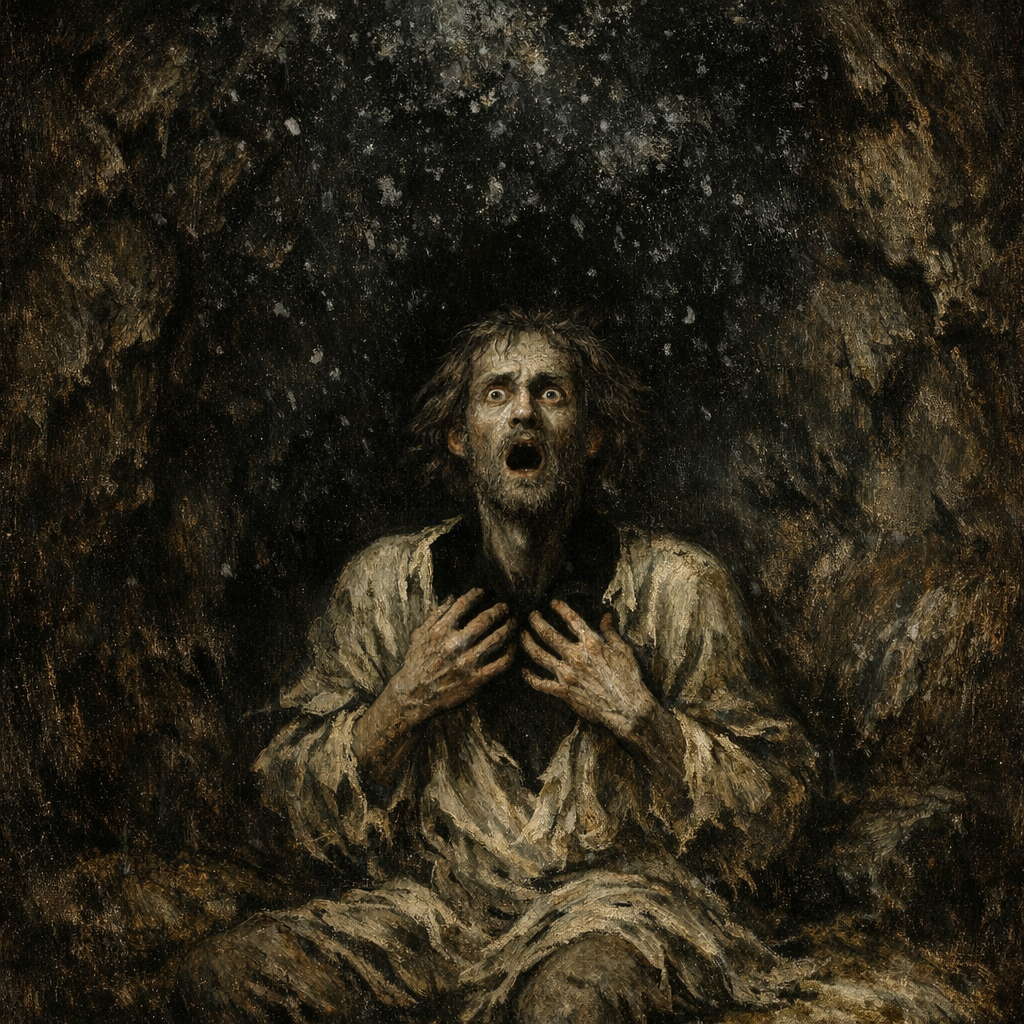
TL;DR: Inside a nightmare that breaks his imagined kingdom of smells, Grenouille discovers that he himself has no personal scent — wakes in absolute darkness, gropes at his own body for confirmation, and understands for the first time that he is, in his own register of reality, not there.
Spoilers through Chapter 28.
The seven-year peace ends in a single dream that strips Grenouille of the one thing he had not realized he was missing.
What happens
The chapter begins inside the scent palace of chapter 27 and lets it begin to fail. Particles dim. Halls collapse into smoke. Grenouille, at the center of his own architecture, registers a missing chamber — and reaches for the one room he has never built. There is no Grenouille-chamber. There is no scent for the man who has remembered every other scent in his life.
He wakes bolt upright on the moss bed, in absolute dark, both hands brought to his own chest in the gesture of checking himself for scent. Nothing. He sniffs his arms, his palms, his collar — nothing. The void Father Terrier registered in chapter 3, the void the wet nurses smelled in chapter 2, the void Madame Gaillard could not detect because she could not smell anything in chapter 4 — Grenouille himself, at the center of his own imagined universe, has just discovered.
The chapter ends with him sitting upright in absolute darkness, having understood that he must do something about it. He cannot continue not existing.
Key moments
- The collapsing palace. The dream's slow loss of light.
- The missing chamber. The room that has never been built.
- The hands at the chest. The smallest gesture in the chapter and the book's most exact image of horror.
Character shifts
Grenouille's project changes shape. Before this chapter, his work was about capturing scent. After this chapter, his work is about manufacturing a scent for himself. The murders that begin in Part 3 are downstream of the discovery in this cave.
Why it matters
This is the book's central revelation chapter and arguably its most important. Perfume's structural premise — that a man with no scent of his own will eventually have to make one — is established in chapter 1 by absence and confirmed here by recognition. Everything after is consequence.
Themes to notice
- Identity as something you have to make for yourself — its purest formulation. Grenouille discovers he has not yet started.
- Worship as the most dangerous reflex — its inverse: the absence of any thing to be worshipped, which the protagonist will spend the rest of the book correcting.
Book club questions
- Süskind has been quietly preparing this revelation since chapter 1. Did the build land for you — and if not, where did it slip?
- Is the chapter horror, or is it self-knowledge? Where exactly is the line?
- Grenouille reacts to this discovery with neither despair nor relief — he simply plans. What does the absence of an emotional response tell you about him?
Visual memory hook
A gaunt ragged figure sitting bolt upright on a moss bed in absolute darkness, hands brought to his own chest in the gesture of checking himself for a scent that isn't there, the imagined nebula of scent particles dissipating around the cave walls — only his silhouette stays empty.
What's next
Chapter 29 lets him out.