
Chapter 18
The chapter in one sentence
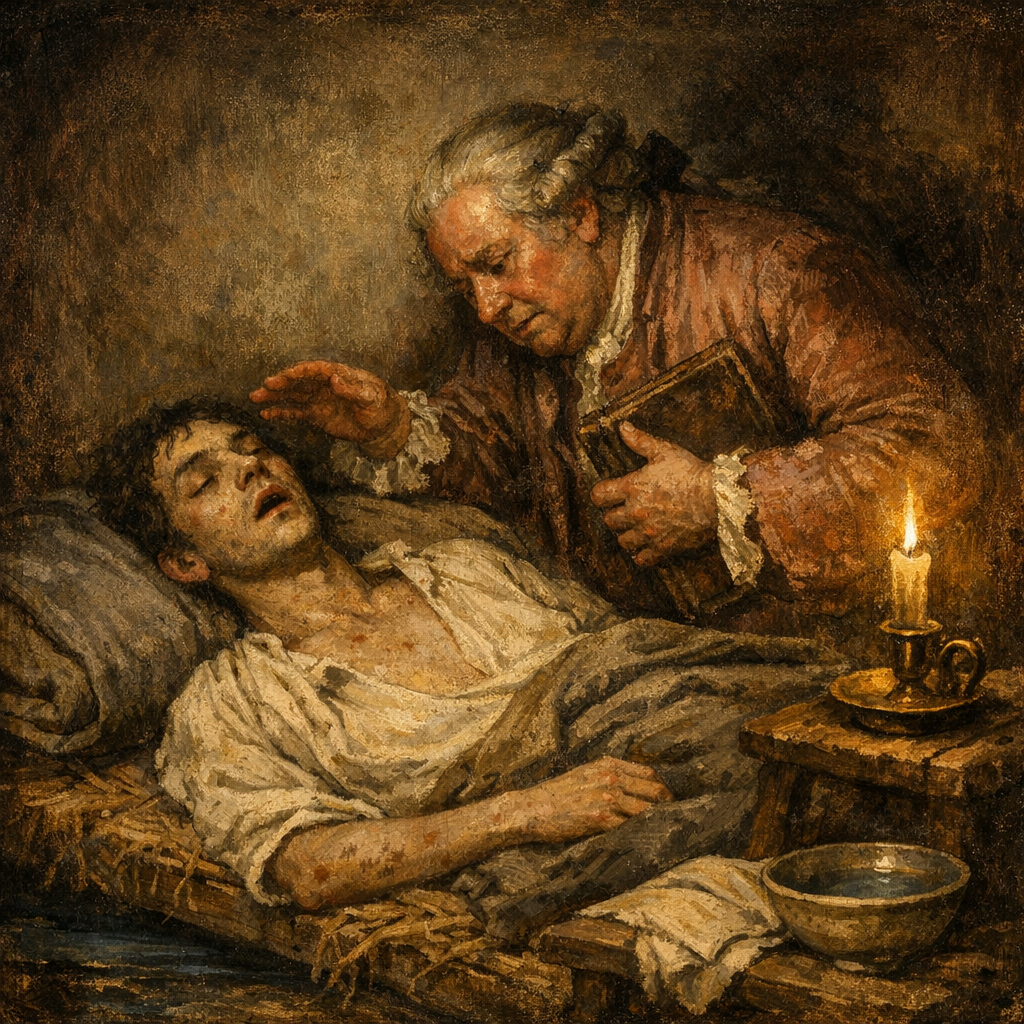
TL;DR: Grenouille is struck down by recurring anthrax fever in the back-room sleeping alcove of the perfumery, and Baldini — terrified of losing the source of his fortune more than the boy in his employ — hovers at the pallet with the recipe ledger clutched to his chest, fearing the wrong loss.
Spoilers through Chapter 18.
The illness chapter clarifies what each man cares about and reveals, in a single bedside image, the moral economy of their relationship.
What happens
The same anthrax that nearly killed Grenouille at the tannery in chapter 5 returns. He collapses on the straw pallet in the back room. Sweat-pale, blotched, half-conscious. The Seine slaps the pilings beneath the floorboards.
Baldini — who would have to hire half the Pont au Change to replace what one boy has been producing for him — hovers above the pallet with one hand half-raised over Grenouille's brow without ever touching it, and the other clutching the leather-bound formulary to his chest. The image is exact: Baldini fearing that Grenouille will die before he can extract more recipes. The prose does not soften the calculation.
The fever passes; the boy survives, again. The shop's production resumes, but the chapter has made a thing visible that cannot be unseen.
Key moments
- The collapse. Quiet, undramatic, midweek. The boy has been overworked.
- The bedside. Baldini's hand half-raised, the ledger pressed to his chest. The book's coldest portrait of an employer.
- The recovery. Süskind grants it offstage. Grenouille survives because he survives.
Character shifts
Baldini's anxiety about Grenouille's mortality crystallizes; the next two chapters will see him protecting his investment by extracting as many recipes as the boy will give him before something inevitable happens. Grenouille, recovered, has been quietly shown the limits of trusting Baldini's care.
Why it matters
The chapter is the moment Grenouille begins, internally, to plan his exit. Baldini's bedside image — recipes saved before life — tells him what kind of man he is working for, and the next chapters will see him decide on his terms.
Themes to notice
- The artist as monster, the monster as artist — and the handler of the artist as a different kind of monster.
- Pre-Revolutionary France as a body that knows it's rotting — the same anthrax, the same body, the same kind of survival the fish market produced in chapter 1.
Book club questions
- Baldini is, in this chapter, doing exactly what a small businessman would do: protect his asset. Is the book scolding him, or simply describing the economy he's living in?
- Grenouille recovers without comment. What does the lack of a recovery scene tell you about who Süskind thinks the chapter is about?
Visual memory hook
A small thin scarred boy lying twisted on a straw pallet in a candle-lit back room, a heavy-set master in a dusty-rose silk waistcoat leaning over him with a leather-bound recipe ledger clutched to his chest and a hand half-raised over the boy's brow without touching him.
What's next
Chapter 19 lets the surviving boy state his terms.