
Chapter 15
The chapter in one sentence
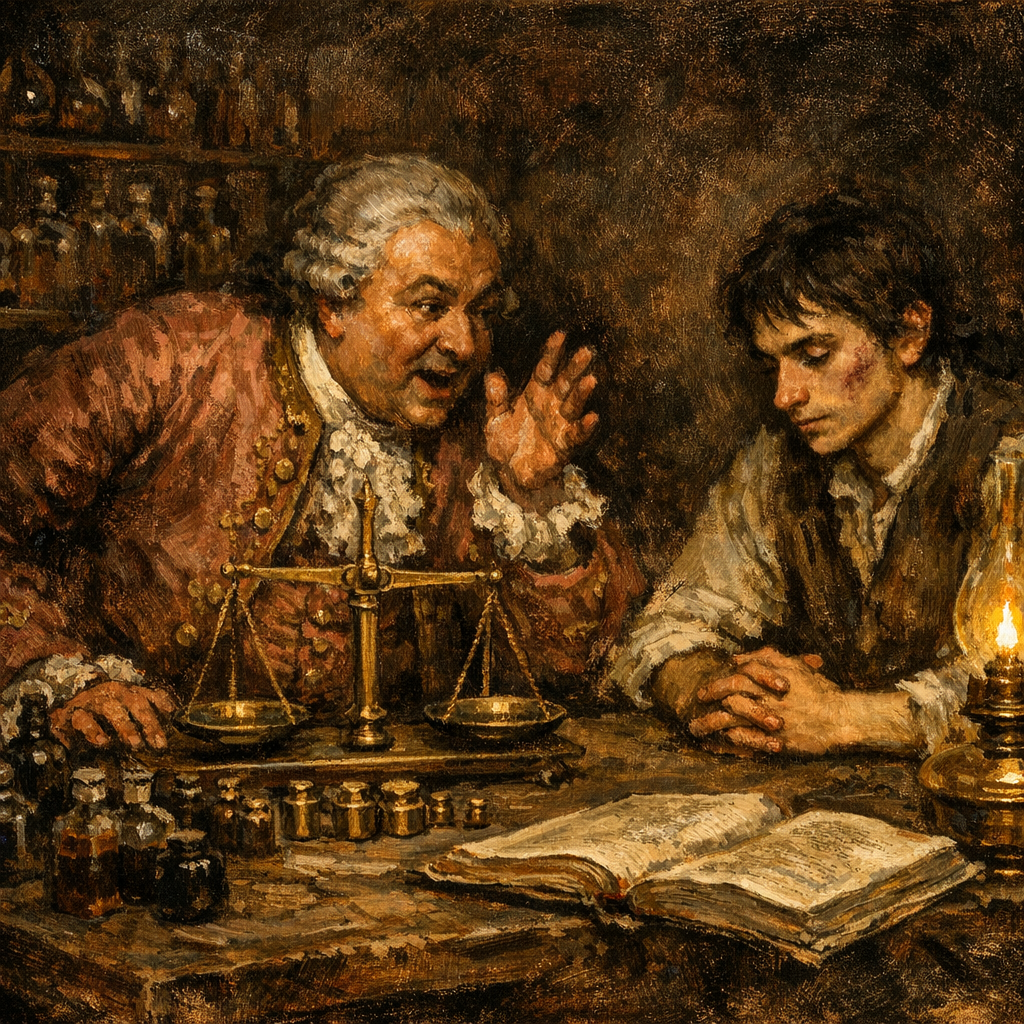
TL;DR: Under warm lamplight in his back-room laboratory, Baldini drills Grenouille in the formal trade — formula, weights, percentages, labels — and Grenouille, while listening with the body language of the dim and dutiful, silently demonstrates that he needs none of it.
Spoilers through Chapter 15.
The master perfumer attempts to teach his apprentice a craft the apprentice has, undetectably, been performing for two chapters already.
What happens
Baldini settles into the role of master with theatrical satisfaction. He drills Grenouille on the brass balance — the proper weights, the proper proportions, the proper labels, the proper Latin names of resins. He gestures grandly toward the shelves; he taps the formulary with a fluttering hand. Grenouille listens with downturned eyes and a faintly bored stillness, hands folded, body of a boy who already knows everything being explained.
The chapter is a structural joke. Baldini is the one who needs the instruction; Grenouille is the one who could give it. Süskind plays the lecture for slow comedy: every sentence Baldini delivers is technically accurate and entirely beside the point.
Key moments
- The balance lesson. Baldini's reverence for measurement, performed for an apprentice who has already proved he doesn't need to measure.
- The Latin names. Süskind's quiet deflation: a master whose authority is mostly vocabulary.
- Grenouille's stillness. The chapter's load-bearing image. He is not bored in any human sense; he is waiting.
Character shifts
Baldini consolidates the role he will play through Part 1: theatrical instructor, terrified employer, ledger-keeper of recipes that aren't his. Grenouille begins his patient extraction of the only thing Baldini actually has to teach him — the infrastructure of the perfumer's trade, the formal license to call himself a journeyman.
Why it matters
The chapter establishes the lopsided rhythm of the next several chapters: Baldini lecturing, Grenouille making, the shop succeeding, neither party able to acknowledge what's actually happening. It also seeds, quietly, what Grenouille is actually after — not knowledge, but papers.
Themes to notice
- The artist as monster, the monster as artist — its understated working form: the artist sits silently and lets the master pretend to be one.
- Identity as something you have to make for yourself — Grenouille is now constructing a trade identity that will allow him to leave Paris with a journeyman's pass.
Book club questions
- Süskind plays the master-pupil dynamic for comedy. Is it kind comedy or cruel comedy?
- Grenouille could correct Baldini at any point. He doesn't. What does the silence cost him, and what does it earn him?
Visual memory hook
A heavy-set master in a powdered wig theatrically tapping a brass balance, lecturing — and, across the worktable, a small dark hunched apprentice in plain linen, hands folded, eyes downcast, waiting.
What's next
Chapter 16 shifts the lessons from theory to practice — and produces the moment Baldini can no longer pretend he is the better perfumer in the room.