
Chapter 1
The chapter in one sentence
TL;DR: A Paris fishwife gives birth alone beneath her market stall on July 17, 1738, attempts to leave the newborn in the offal heap to die — as she has done with four prior infants — but the baby's cry exposes her, the watch arrests her on the spot, and Jean-Baptiste Grenouille begins his life as the sole confessed survivor of a serial infanticide his mother is hanged for.
Spoilers through Chapter 1.
Süskind opens his novel by telling you, with cold clinical care, exactly the conditions of birth required to produce the protagonist of the book you're about to read.
What happens
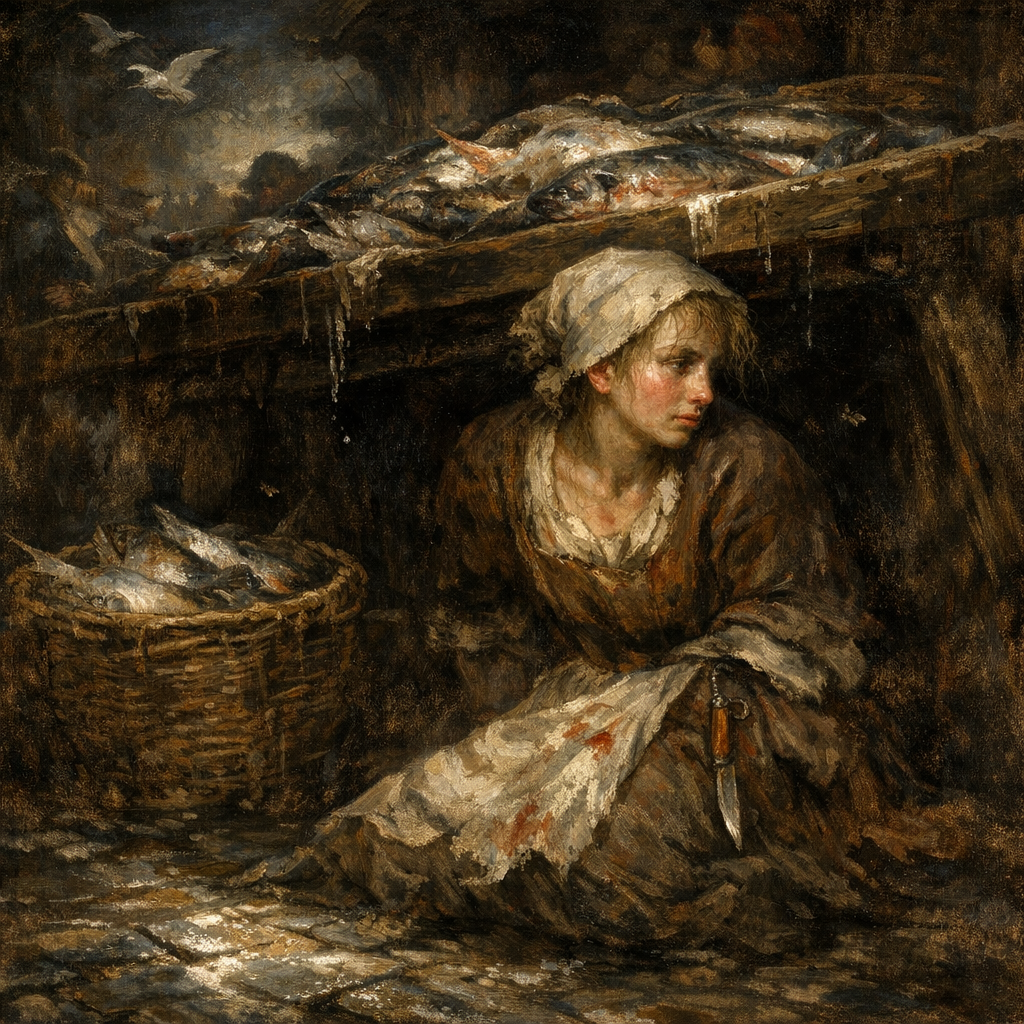
It is high noon in a Paris fish market on a sweltering July afternoon. A young, exhausted fishmonger's assistant — unnamed throughout the book — ducks under her plank stall, gives birth on the slimed cobbles, severs the umbilical cord with a crusted gutting knife, and walks back to her work, leaving the newborn in the heap of fish heads and viscera beneath the table.
The infant cries. The market hears it. The women working nearby drag the bloody child out of the offal, shout for the watch, and arrest his mother at her stall. Under questioning she admits, calmly, to having let four previous infants die in the same way. The novel notes the mathematics: she gives birth, lets the baby suffocate in the refuse, returns to gutting fish, recovers her work, repeats. This is the fifth.
She is tried for serial infanticide and publicly executed. The infant — nameless, scentless, possessed only of the lungs that betrayed his mother — is taken away by the authorities and shipped onward to a wet nurse.
Süskind grants her one paragraph of pragmatic backstory and no interiority at all. The chapter is interested not in her psychology but in the conditions: 1738, a fish market, an exhausted woman, a city in which this is a routine event. The protagonist of the book has been delivered.
Key moments
- The birth under the stall. Algae-slick stones, a crusted knife, a heap of scales and entrails, a baby left to suffocate in plain sight. The novel's clinical register is established in two pages.
- The cry. Grenouille's first act in the world is to be heard. Every consequence in the chapter, including his mother's execution, is downstream of the lungs Süskind chooses to give him.
- The arrest and the confession. The mother's matter-of-fact admission to the previous four deaths is the book's first portrait of how unsentimental this Paris is, and how routine such crimes are.
Character shifts
The mother, in the space of one chapter, is born into the book, framed as monstrous, contextualized as ordinary, and disposed of. Grenouille is born — and the narrator notes, almost in passing, that he carries no baby-smell, which the wet nurses in the next chapter will care about much more than the parish does.
Why it matters
Every later chapter of Perfume is a consequence of this one. The book's argument that a society stinks because of how it is organized starts here: the fish market, the offal heap, the routine infanticide, the woman who is more or less correct that she is doing a normal thing for her circumstances. Süskind also establishes his narrator's signature distance — the "and-this-is-how-people-ate-cabbage" tone he will use to describe Grenouille's twenty-five later murders. The reader is being trained, in the first chapter, to receive horror in a register that does not flinch.
It also gives Grenouille his date of birth (July 17, 1738) and his structural orphanhood. He has no family, no community, no recorded existence — he is dropped into the world without any of the categories the rest of 18th-century French life uses to attach a self to a person. The book will spend the next 50 chapters letting him try to make one.
Themes to notice
- Pre-Revolutionary France as a body that knows it's rotting — established here with the literal heap of rot under the fish stall.
- Smell as the sense reason can't argue with — the wet nurses in chapter 2 will perceive what the parish here does not.
- Identity as something you have to make for yourself — Grenouille begins life with nothing. No name, no smell, no claim.
Book club questions
- Süskind opens the novel with the words "In eighteenth-century France there lived a man who was one of the most gifted and abominable personages…" He gives you the verdict in line one. What does that change about how you read the birth scene?
- The mother is granted no interior life and no name. Is Süskind dehumanizing her, or refusing to dignify her with a psychology she didn't grant the four previous infants?
- The novel's first detail is that Paris in 1738 is hot, rotting, and routinely sheltering this kind of crime. Does the period setting protect the reader from the violence, or implicate the reader more?
Visual memory hook
Silver fish scales adhering like sequins to the cobbles, a gutting knife on a leather string, a swarm of black flies, a cry rising out of an offal heap on a noon-bright July day. This is the only image Süskind gives you of the woman who made his protagonist; hold it.
What's next
Chapter 2 picks up the bundle the parish carries away from the fish market, hands it to the first of several wet nurses, and lets the women whose job is to know what babies smell like deliver the diagnosis the priest in chapter 3 will refuse to believe.