
Chapter 26
The chapter in one sentence
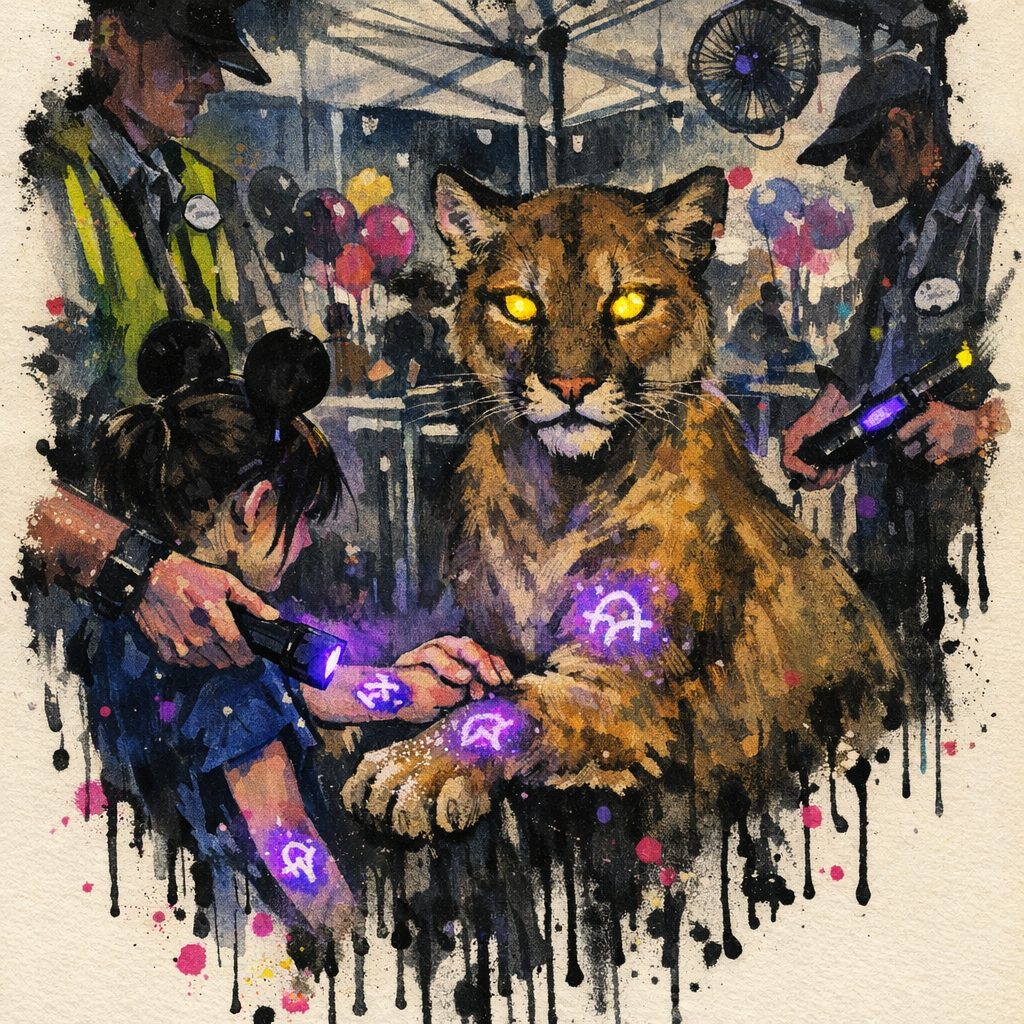
TL;DR: Inside the park, the lion becomes a pettable spectacle — UV stamps blooming purple on tawny fur, strangers' churro-sticky hands stroking down the spine, phones rising for selfies — a predator wearing a leash made of attention.
Spoilers through Chapter 26.
The lion is petted by strangers all day.
What happens
Little slaughter guides the mountain lion through the entrance gauntlet, where fluorescent-vested staff and a blacklight bulb mark them for re-entry; the lion's coat takes the stamp too — a purple bloom against gold. The park's concrete radiates heat and fryer oil while mouse-ear crowds drift past, and hands reach down without asking — greasy with churro sugar, sunscreen-slick — stroking along the spine as phones rise for selfies. Each time they step out to the esplanade and back in, another stamp blooms — a constellation of symbols glowing under the scanner like small bruises. Children squeal kitty, influencers coo, cast members smile with trained brightness, and the lion endures the parade curb like a celebrity on a low stage. As dusk falls, bubble-wand rainbows and balloon bouquets bob above them, and fireworks ash freckles whiskers while the lion tastes sanitizer and cinnamon on the tongue. The absurdity of being safe inside danger — a predator posing as support animal — tightens around them like a collar made of attention.
Key moments
- The UV stamps. Purple sigils blooming on gold fur under blacklight. The book's most beautiful image of mediated identity.
- The petting. Strangers' hands on a wild animal. Children calling kitty. The book's most quietly horrifying running gag.
- The collar of attention. Hoke's exact phrase. Restraint as something the crowd, not the leash, supplies.
Character shifts
The lion endures. The verb is precise. They do not enjoy the stranger-petting; they do not bolt; they do not bite. They sit on the curb like a celebrity on a low stage. Heckit's posture in the second half is established here: available, watching, waiting.
Why it matters
Chapter 26 is the book's most distilled satire and its most distilled tenderness in the same paragraphs. Hoke wants us to feel the absurdity (a cougar getting petted by a teen with churro hands) and the beauty (UV stamps blooming on gold fur) at once — and to feel the threat (a predator under a leash made of crowd) under both. This is the book's mature register on full display.
Themes to notice
- Attention as restraint. A leash you can't see; a collar made of looking.
- UV ink on a wild coat. The body marked by entry, re-entry, accumulation.
- The petting as theme. The whole park assumes the lion is for them. The book lets the assumption stand and lets you sit with what that means.
Book club questions
- A collar made of attention. What does the book mean by it, and is the lion the only one wearing one?
- The UV stamps bloom on the lion's coat, not just on her wrist. Why does Hoke insist on marking the animal too?
- Hoke renders the petting as funny and horrifying. Where does each register hit you hardest?
- The lion endures. Is endurance what the second half of the book is about?
Visual memory hook
Tawny fur dappled with purple UV stamps under a blacklight bulb, strangers' churro-sugared hands stroking a spine in line for the parade, balloons mirror-polished and tugging skyward, and a tawny shape sitting on the curb like a celebrity on a low stage.
What's next
A log flume, cold spray, brief joy.