
Chapter 4— History: The First Wave
History: The First Wave
TL;DR: In the 1950s and 60s, a generation of serious scientists made astonishing progress with psychedelic medicine — and then Timothy Leary handed the government the weapon it needed to shut it all down.
Spoilers through Chapter 4 (Chapter Three).
Chapter in one sentence
Pollan chronicles the remarkable first wave of psychedelic research — its pioneers, its unexpected cultural reach, its rapid collapse — and names the man most responsible for the destruction of fifteen years of legitimate science.
What happens
The chapter opens with Humphry Osmond, a British psychiatrist working at a hospital in Saskatchewan in the early 1950s, treating severe alcoholics with LSD therapy and achieving results that no existing approach could match. Osmond was the first to understand that the experience itself — not the chemistry — was the therapeutic mechanism. He also coined the word "psychedelic" in a 1956 letter exchange with Aldous Huxley, who had just published The Doors of Perception after Osmond administered mescaline to him in 1953.
Enter Al Hubbard: an enigmatic, well-resourced millionaire with a mystical Catholic bent and rumored CIA connections who spent the decade introducing LSD to as many influential people as he could reach. Between 1951 and 1965, he administered LSD to an estimated 6,000 people — executives, politicians, generals, scientists, artists. Cary Grant credited LSD therapy with his psychological transformation. Stewart Brand's 1962 Hubbard session gave him the conceptual frame for the Whole Earth Catalog and, through it, personal computing as liberation rather than surveillance.
Then Timothy Leary arrived at Harvard. The chapter covers his trajectory in careful, non-sensationalized detail: genuine intellectual enthusiasm, escalating grandiosity, the creation of a student cult, a scandal, dismissal, and then a sustained public campaign to introduce psychedelics to millions of Americans regardless of context, preparation, or consequences. Osmond traveled to Cambridge to warn him. Leary didn't listen. By 1966, Sandoz had withdrawn LSD from distribution, and the FDA had ordered approximately 60 active research programs to stop. The first wave was over.
Key moments
Humphry Osmond's alcoholism results — Single-dose LSD sessions producing sustained sobriety in patients who had failed every other treatment. The effect sizes are not subtle.
The coinage of "psychedelic" — In a letter to Huxley, Osmond writes: "To fathom hell or soar angelic / Just take a pinch of psychedelic." The word — "mind-manifesting" — stakes out the territory against "psychotomimetic" (mimicking psychosis), which was the establishment's preferred framing.
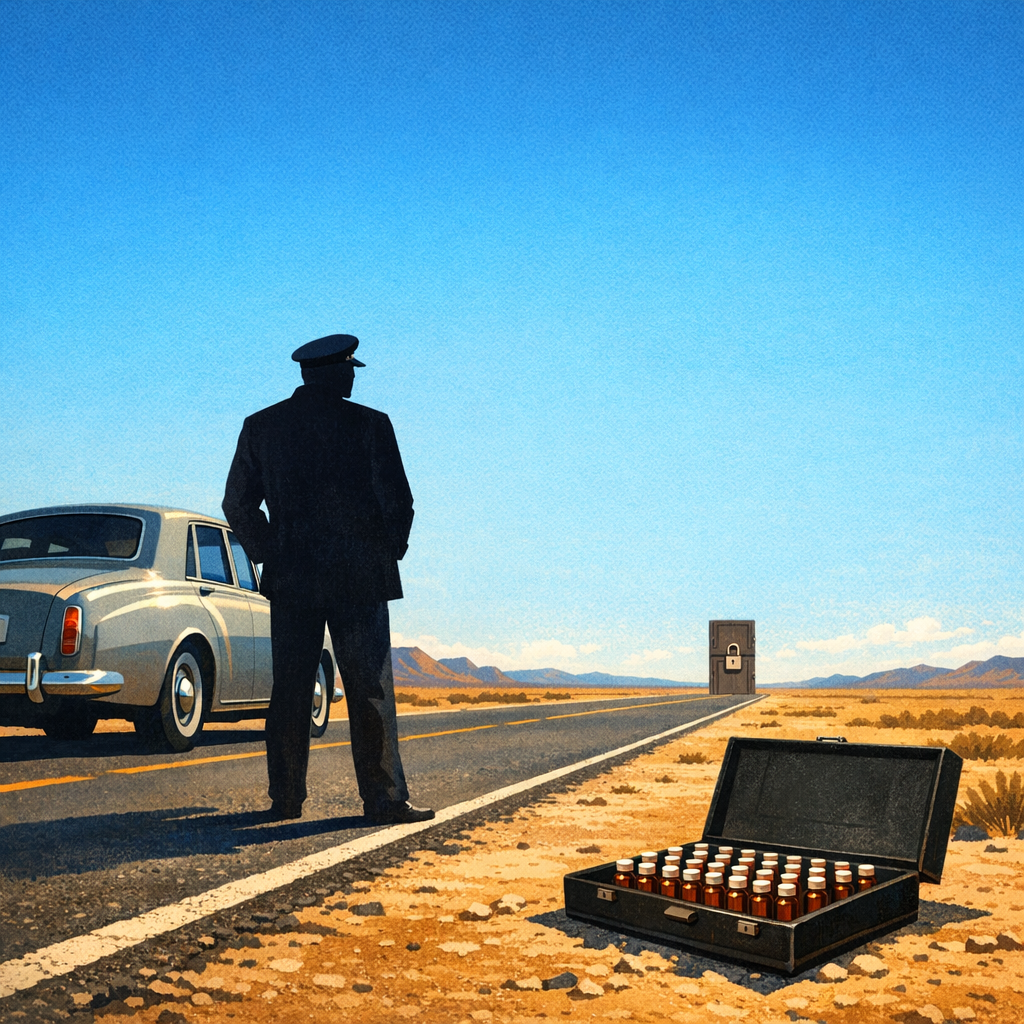
Al Hubbard's Rolls-Royce — He drives cross-country, case of Sandoz vials in hand, personally guided session after session with people who could move institutional needles. His strategy is completely pre-democratic: change the top, the rest follows.
Stewart Brand's session, 1962 — Brand looks down during a Hubbard-guided LSD session, perceives Earth's curvature, and immediately begins lobbying Congress and NASA to take a photograph of Earth from space. The photograph arrives two years later. The Whole Earth Catalog follows. The rest is Silicon Valley history.
Timothy Leary's Harvard collapse — The 1962 Harvard Crimson article exposing Alpert and Leary for providing drugs to students is the visible crack. The years that follow are a public dismantling of scientific credibility at the moment the field needed it most.
Why it matters
Chapter 4 is the book's tragedy. Fifteen years of research. Remarkably consistent results across depression, addiction, alcoholism, end-of-life anxiety. And it ends not because the science failed but because one scientist's ego outran his judgment and the political culture of the 1960s did the rest. The chapter makes the suppression feel specific and avoidable — which is exactly the point.
Themes to notice
- The first and second wave — The book is structured as a history of suppression and revival. This chapter is the suppression.
- The politics of consciousness — Pollan's argument isn't that the government was wrong to regulate dangerous compounds. It's that the regulation was driven by politics and culture, not evidence.
Book club questions
- The book holds Timothy Leary significantly responsible for the suppression of psychedelic research. How much can one person's actions determine the fate of an entire scientific field?
- Al Hubbard's "top-down" strategy — targeting elites — was the opposite of Leary's democratic approach. Which would be the right strategy for the psychedelic renaissance of today?
- Stewart Brand's Hubbard session allegedly contributed, through a long chain of influence, to personal computing. How do you evaluate claims about the civilizational consequences of altered states?
Visual memory hook
A silver Rolls-Royce stopped on a desert highway, a large silhouette against an enormous American sky, a leather case open at his feet. In the far background: a padlocked door, barely visible.